A Single Mom Was Left With Nowhere to Turn—Until a Kind Carpenter Transformed an Abandoned Watermill Into the Home She Never Thought She’d Have!
A Single Mom Was Left With Nowhere to Turn—Until a Kind Carpenter Transformed an Abandoned Watermill Into the Home She Never Thought She’d Have!
Take your things and get out of my house. Daniel, please. Lily is right here. Then leave now. Mommy, where are we going to sleep? I don’t know yet, sweetheart, but we’ll find somewhere safe. Mom, can we really live here? We’ll make it a home together. Grandma, I never thought we’d come back here. Mommy, is this house going to fall down? It’s worse than I remembered.
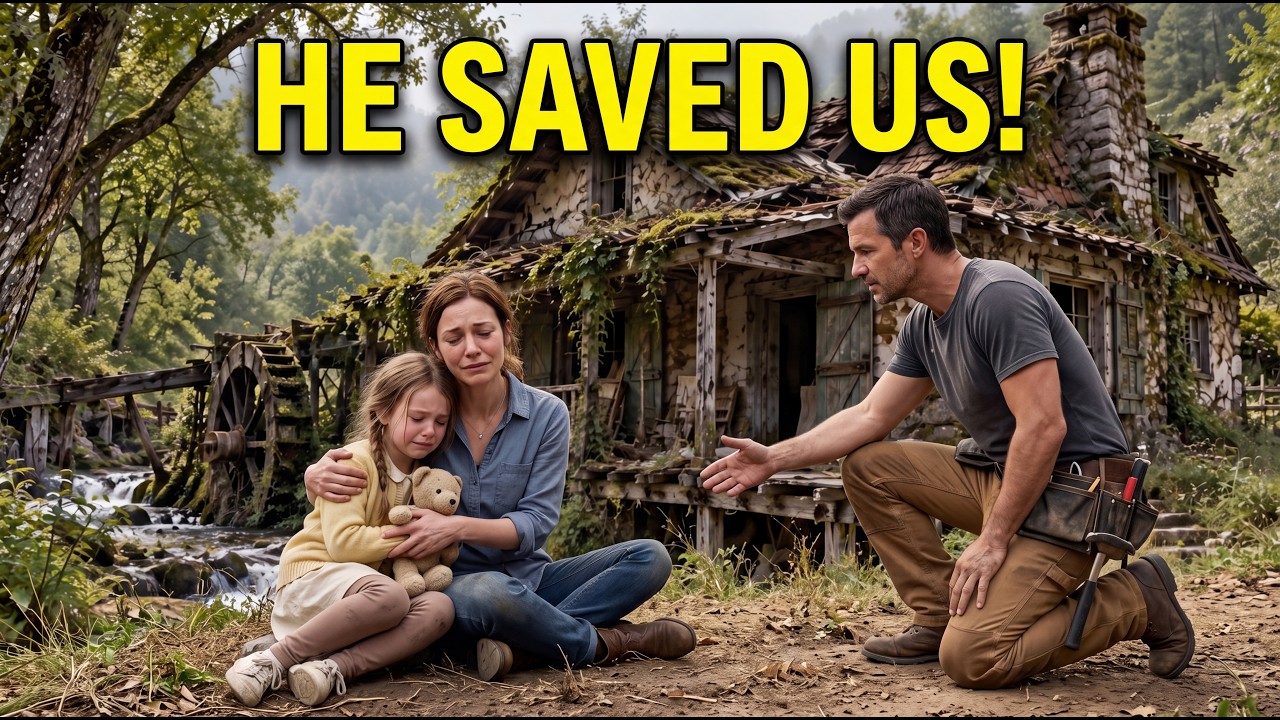
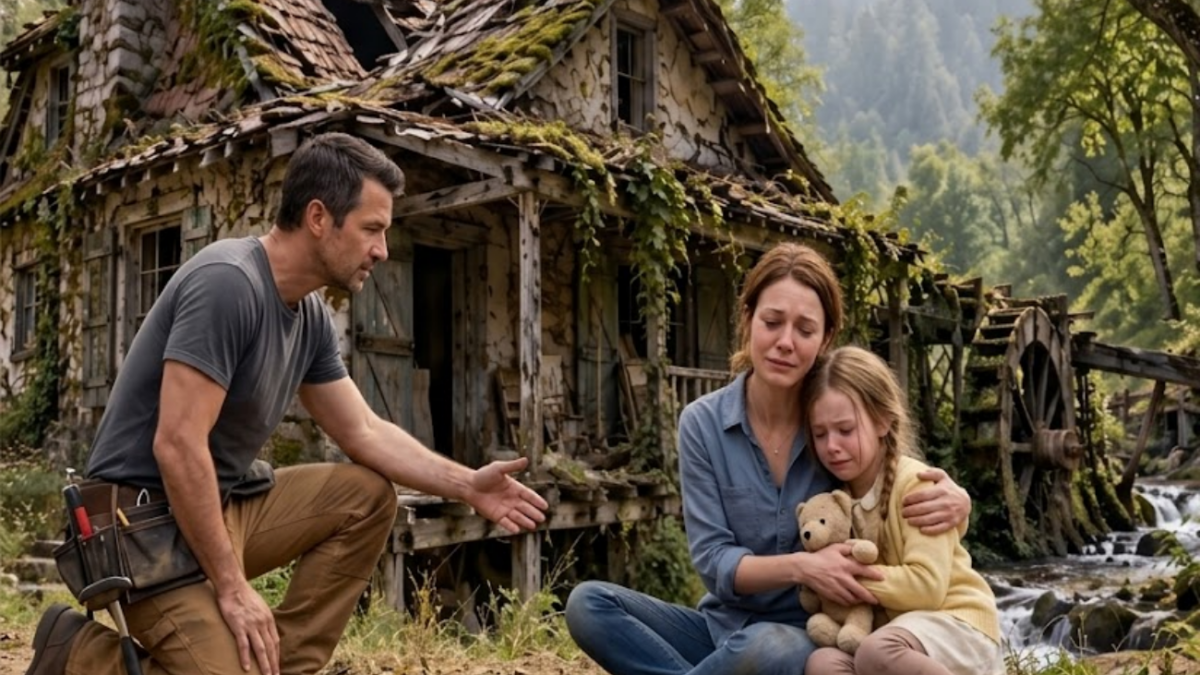
Your great grandma used to sit here with me. Jack, I found Grandma’s old house. I really need your help. I’ll come take a look tomorrow morning. This house needs work, but we can give it a new beginning. Sarah, I’m glad you called me. Thank you for coming, Jack. The roof is badly damaged. We need to secure the structure before taking anything apart.
First, we clear the overgrowth. Then, we’ll carefully take down what’s beyond repair. Okay, let’s bring this place back to life. Heat. Heat. keep the stone walls. Only remove the rotten wood.
The demolition is finished. Next, we strengthen the foundation and rebuild the structure. It looks so different now. We’ve cleared away the damage. Now, we can start building it back.
Heat. Heat. I can finally see our home taking shape. The structure is coming back. There’s still plenty to do. Heat.
Heat. Heat. Mom, is this really our home? Jack, you gave us more than a house. You gave us hope. Thank you for making our dream come true. You both deserve a beautiful new beginning. Sometimes kindness can change an entire life. What would you do to help someone start again? Tell us in the comments.
The sound of the solid oak front door slamming shut was not merely loud; it had the concussive, vibrating finality of a steel trap snapping shut in the dead of night.
On the damp aggregate concrete of the suburban driveway, twenty-seven-year-old Sarah stood entirely frozen. In her left hand, the thin plastic handles of two oversized black contractor trash bags bit deeply into her palm, stuffed haphazardly with winter coats, denim trousers, and a few sweaters yanked from closet hangers in thirty frantic seconds. Her right hand clutched the small, trembling fingers of four-year-old Lily.
The porch light behind them clicked off, plunging the driveway into pitch blackness.
Daniel’s words still hung in the humid evening air, sharp and venomous: “Take your things and get out of my house. I don’t care where you go. Just get off my property.”
“Mommy?” Lily whispered, her small voice thin and shivering as she clutched a ragged, one-eared stuffed rabbit against her chest. “Mommy, where are we going to sleep?”
Sarah stared out at the dark suburban street, where pristine two-story houses sat behind immaculate lawns, their windows glowing with the warm, safe amber of dinner tables and television sets. Her throat tightened with a suffocating, visceral terror. Her checking account contained precisely forty-two dollars. Her credit card had been maxed out weeks ago on groceries and pediatric prescriptions. Her parents were gone, and the few acquaintances she had made since moving to the valley were Daniel’s friends—people who would look at her sudden eviction with polite embarrassment and closed doors.
She had nowhere to go. No hotel, no family, no shelter bed that wasn’t already waitlisted three weeks deep in the county seat.
“Mommy will find us a place, baby,” Sarah whispered, kneeling on the cold asphalt and pulling the little girl into her arms so Lily wouldn’t see the hot tears spilling down her cheeks. “I promise you. We’re going to find somewhere safe.”
Standing in the glow of the dashboard inside her dented, ten-year-old hatchback, Sarah opened the glove compartment. Beneath expired insurance cards and repair receipts lay a worn, yellowed manila envelope inherited from her late grandmother. Inside was a legal deed, frayed at the folds, stamped by the county recorder decades ago.
It was a deed for an unaddressed, three-acre tax parcel tucked deep in the Appalachian foothills along Blackwood Creek.
As a child, Sarah had listened to her great-grandmother recount stories of the family’s ancestral homestead—a nineteenth-century grist mill powered by a rushing mountain stream, where farmers from three ridges had brought their corn and wheat to be ground into flour. The mill had been abandoned before Sarah was born, left to the elements when industrial grain elevators rendered small-scale watermills obsolete. For forty years, it had sat forgotten on the county tax rolls, its taxes paid in negligible annual sums simply to keep the family name on the dirt.
With the fuel gauge hovering a hair above empty, Sarah turned the key. The starter groaned, the four-cylinder engine rattled to life, and she steered the car away from the suburban subdivision, leaving behind the only life Lily had ever known and driving toward the pitch-black ridgelines of the hollow.
The Phantom of Blackwood Creek

The paved county road gave way to washboard gravel, then to a rutted, single-lane dirt track choked with mountain laurel and wild blackberry brambles. Tree branches scraped against the car’s rusted quarter panels with metallic screeches as the vehicle crawled deeper into the valley, following the thunderous, invisible roar of cascading water.
When the headlights finally swept across a small clearing at the bottom of the gorge, Sarah hit the brakes, her knuckles turning bone-white on the steering wheel.
Rising out of the swirling mountain mist was a specter of absolute devastation.
The old watermill was colossal, its three-story silhouette carved out of massive, hand-chiseled native fieldstone and blackened heart-pine timbers. But time, weather, and neglect had exacted a catastrophic toll.
The roof had suffered an almost complete structural failure; heavy cedar shakes and rotting purlins had caved in, leaving a gaping wound that exposed the upper rafters to the open sky like the ribcage of an ancient whale. Ivy as thick as a man’s forearm crawled up the masonry, prying the mortar from the granite seams. Half of the wooden millrace—the elevated flume that once funneled stream water to the wheel—had collapsed into the creek bed, its rotted timbers half-buried in river silt and gravel.
And the great wooden waterwheel itself, twelve feet in diameter, sat seized and canted at an unnatural angle against the stone foundation, choked with drift logs and dead river weeds.
Lily pressed her nose against the passenger window, her eyes round with horror. “Mommy… is this house going to fall down?”
Sarah switched off the ignition. The headlights died, leaving the clearing illuminated only by the pale, cold sliver of an autumn moon. The roar of Blackwood Creek filled the car—wild, beautiful, and completely indifferent to their survival.
“It’s worse than I remembered,” Sarah breathed, her heart sinking into a bottomless hollow.
Yet, as she stepped out into the damp mountain air and walked toward the heavy timber threshold, her flashlight beam caught the cornerstone beside the archway. Chiseled into the granite was the year 1874, flanked by her great-grandfather’s initials.
The air inside the ground floor was freezing, smelling of ancient wet stone, oak tannins, and decades of settled river mud. But as Sarah swept the beam across the walls, she noticed something extraordinary: the lower masonry, constructed from granite river boulders over two feet thick, stood completely plumb. The original builders had anchored the foundation directly into the bedrock of the gorge. The roof was gone, the upper framing was rotted, and the interior floors were a treacherous maze of damp timber, but the stone skeleton remained unyielding.
That night, Sarah did not sleep.
She laid the car’s rear seats flat, bundled Lily into three layers of wool blankets and coats, and sat in the front passenger seat with a tire iron across her lap, watching the silhouettes of the hemlocks sway against the broken roofline of the mill. Every snap of a twig outside made her pulse spike.
As dawn broke over the eastern ridge, painting the mist in pale ribbons of rose and gold, Sarah pulled out her cracked mobile phone. She had one bar of signal, bouncing off a distant tower on the highway ridge.
She opened her contacts and scrolled to a name she had not dialed in six years: Jack Miller.
Jack had grown up in the valley, two years ahead of her in high school. He was a quiet, broad-shouldered man with steady hands, a master carpenter and timber framer who had spent his adult life restoring historic barns, covered bridges, and log cabins throughout the Appalachians. He was a craftsman of few words, known across the county for his encyclopedic knowledge of traditional joinery and an uncompromising, stubborn sense of honor.
Sarah pressed the call button, her hand shaking as the phone rang once, twice, three times.
“Miller Carpentry,” a calm, low baritone answered.
“Jack?” Sarah whispered, her voice breaking on the syllable. “Jack… it’s Sarah. Sarah Jenkins.”
A pause echoed over the static. “Sarah? Where are you? You sound like you’re in a tunnel.”
“Jack, I’m at the old watermill,” she choked out, fighting back a fresh wave of tears. “My great-grandmother’s mill on Blackwood Creek. Daniel threw us out last night. We have nowhere else to go. The roof is collapsed, the wood is rotted, and I don’t know what to do. I need help. I really need your help.”
There was no hesitation. No questions about Daniel, no polite apologies, no calculation of hourly rates.
“Stay at the site, Sarah,” Jack said, his voice dropping into a register of ironclad certainty. “Keep Lily in the truck. I’m loading my flatbed right now. I’ll be there in twenty minutes.”
The Carpenter’s Diagnosis
The throaty rumble of a heavy-duty turbodiesel engine announced Jack’s arrival long before the truck rounded the final bend.
A battered, slate-gray one-ton flatbed truck rumbled into the clearing, its steel racks loaded with hydraulic jacks, heavy chain hoists, structural timbers, and stacks of commercial-grade canvas tarpaulins.
Jack Miller stepped out of the cab. He was in his early thirties, clad in a heavy duck-canvas work jacket, scuffed leather boots, and a worn ballcap. His beard was trimmed close, and his eyes—the color of weathered slate—took in the entire scene in three deliberate, sweeping glances: the dented car with clothes piled in the backseat, the shivering four-year-old girl peeking through the glass, and the crumbling, magnificent ruin of the stone watermill.
“Sarah,” Jack said, stepping forward. He didn’t offer an awkward handshake; he reached out with his heavy, calloused hands and caught her trembling shoulders, steadying her as she leaned into him for a brief, shuddering second. “I’m glad you called me.”
“Thank you for coming, Jack,” she murmured, wiping her face. “Look at this place. I’m crazy, aren’t I? A woman with forty dollars trying to sleep in an abandoned ruin. Tell me the truth. Is it completely lost?”
Jack turned toward the mill, stepping through the knee-deep wild ferns until he reached the eastern wall. He pulled a four-foot brass-bound level and a heavy twenty-two-ounce framing hammer from his belt.
He didn’t just look; he listened. He struck the ancient cornerstones with the flat of the steel hammer, listening to the high, ringing pitch of solid granite. He placed the level against the mortar lines, climbed the rotted exterior stone stairway to the second-story sill, and peered into the cavernous, open-air interior.
“The roof is a total structural loss,” Jack said, his voice analytical, stripped of false optimism. “The white pine rafters rotted out forty years ago, and when the ridge beam broke, it pulled the upper timber knee-braces down with it. That ceiling above the main machinery floor is a death trap—one heavy wet snow and the whole third level drops onto the stones.”
Sarah’s shoulders slumped, her chin dropping to her chest. “I knew it.”
“Hold on, Sarah,” Jack said, descending the stone steps with agile, deliberate movements. He stopped in front of her, wiping stone dust from his palms onto his canvas trousers. “I told you what’s broken. Now listen to what’s alive.”
He pointed to the massive foundation blocks anchoring the structure into the churning waters of the creek.
“This foundation was laid by master masons who understood hydrostatic pressure,” Jack explained, a spark of reverence igniting in his gray eyes. “These lower walls are double-wythe river granite, three feet thick at the water line, bedded directly onto metamorphic slate bedrock. There is zero subsidence. The walls haven’t tilted a sixteenth of an inch in one hundred and fifty years. And those primary horizontal tie-beams across the lower span? That’s virgin, tight-grain American chestnut. Termites can’t chew it, moisture can’t rot it, and time can’t bow it.”
Jack looked from the ancient stone archway toward Lily, who had climbed out of the car and was standing timidly behind her mother’s coat.
“This house is wounded, Sarah,” Jack said softly. “It’s neglected, and it’s broken. But it has bones of pure iron. We can give it a new beginning.”
“Jack, I don’t have money to pay a construction crew,” Sarah whispered, her face burning with humiliation. “I can’t pay for a new roof. I can’t pay your day rate.”
Jack walked to the tailgate of his truck, dropped the heavy steel chains, and hauled down a fifty-pound tool chest with an authoritative thud.
“Did I hand you an invoice, Sarah?” Jack asked, looking up under the brim of his cap. “You have two strong hands, don’t you?”
“Yes.”
“Then you’re my labor crew,” Jack declared. “First, we clear the overgrowth. Then we carefully take down what’s beyond repair. We save the stone, we save the chestnut, and we build this house back from the bones out. Now let’s get to work.”
Phase One: The Surgical Demolition
The transformation of the Blackwood watermill began not with the laying of new materials, but with an aggressive, systematic excavation of forty years of decay.
Jack established an operations camp in the clearing within two hours. He unrolled two massive heavy-duty rubberized canvas tarpaulins across the most stable quadrant of the ground-floor ceiling, securing them with steel aircraft cables and tensioning turnbuckles to create an immediate, waterproof shelter over what had once been the dry-milling room.
Using an industrial gas-powered generator on his truck bed, he ran heavy-duty commercial drop cords into the stone chamber, setting up two 5,000-watt electric ceramic space heaters. By noon, the interior of the ground floor was dry, warm, and illuminated by portable LED floodlights.
“Lily,” Jack called out, kneeling down to the four-year-old’s height and presenting her with a miniature yellow plastic tape measure and a clean pair of child-sized leather garden gloves. “You are the safety inspector. Your job is to stand on this dry canvas mat and tell me if you see any spiders trying to steal our nails. Think you can handle that?”
Lily’s eyes lit up with fierce determination. “I can find all of them, Mr. Jack.”
“That’s my girl,” Jack smiled.
For the next four days, the hollow echoed with the relentless sounds of demolition.
Jack and Sarah worked twelve-hour shifts from dawn until dusk. Jack wore a heavy climbing harness, anchoring himself with safety lanyards to the stable stone chimney stack while he moved across the precarious upper reaches of the third-story framing. With a heavy gas-powered rescue saw and a three-foot wrecking bar, he methodically severed the rotted white pine rafters, dropping the spongy, waterlogged timber sections into the interior courtyard where Sarah hauled them outside with a heavy steel wheelbarrow.
“Keep the stone walls clean!” Jack yelled down over the scream of the saw. “Do not let any heavy lumber strike the mortar joints! If an oak timber is gray on the outside but sounds dense when you hit it with the hammer, stack it on the gravel pad! We don’t burn anything that can be planed down!”
Sarah worked until her muscles burned with an intensity she had never experienced in her life. Her palms, soft from office work, formed thick, angry blisters that broke and hardened into calluses beneath heavy leather gloves. Her jeans were caked with hundred-year-old soot, plaster dust, and wet river moss.
Yet, with every wheelbarrow of rotted debris she hauled out of the building, the suffocating panic that had paralyzed her on Daniel’s driveway began to lift.
By the fifth evening, the diseased, rotted crown of the mill had been completely excised. The interior was swept down to the solid, unyielding chestnut structural subfloor. The setting sun poured golden light directly into the ground floor, illuminating a clean, three-thousand-square-foot open stone hall completely cleared of poison ivy, bat nests, and rotted rafters.
Standing beside the roaring waters of the millrace, wiping grease and river silt from her face with a bandanna, Sarah looked at the structure.
“The demolition is finished, Jack,” she panted, her chest heaving with pride.
Jack leaned against his truck, taking a swig of water from a stainless steel jug. A slow, approving grin spread across his face as he looked at her calloused hands and soot-stained cheeks.
“Now the fun starts, Sarah,” Jack said. “Next, we strengthen the foundation, and we rebuild the structure.”
Phase Two: Heavy Timber and Living Rock
The reconstruction of a nineteenth-century mill requires engineering principles that modern suburban tract builders have long forgotten. You cannot frame a river mill with two-by-four spruce studs and drywall screws; the building lives in constant dialogue with the violent, dynamic hydraulic energy of the rushing stream.
Jack spent two full days down in the freezing spray of Blackwood Creek, wearing neoprene chest waders, inspecting the underwater masonry footings.
Using an pneumatic mortar pump and a specialized hydraulic lime mixture designed to cure underwater, Jack and Sarah repointed every submerged granite seam, sealing fissures where fifty years of river currents had eroded the binding. They poured five yards of high-early-strength structural concrete around the river-facing abutment, anchoring the foundation permanently into the slate shelf beneath the rapids.
Then came the heavy timber framing.
Rather than buying overpriced, kiln-dried structural lumber from a commercial chain, Jack tapped into his network of local rural sawyers. Two days later, a logging truck backed down the narrow gravel trail, carrying twenty massive baulks of green, rough-sawn white oak—twelve-by-twelve-inch timbers, twenty-four feet long, smelling of rich mountain sap and raw earth.
“Traditional mortise-and-tenon framing,” Jack explained, demonstrating the technique on a makeshift sawbuck in the clearing. “No metal fasteners in the primary joints. Steel nails shear when the seasons expand the timber. Oak pegs—trunnels—expand and contract with the frame. This structure will breathe as long as that river runs.”
For three weeks, the valley became an outdoor timber studio.
Jack laid out the framing geometry using framing squares and traditional layout knives, marking the precise mortise pockets and tenon tongues. Sarah learned how to operate the heavy, four-cycle timber mortiser, plunging the auger bits into the dense white oak to hollow out the joints. Lily sat nearby on a clean timber stack, carefully coating every carved oak trunnel with linseed oil to prevent splitting.
To raise the massive posts and primary cross-girts without an expensive crane, Jack erected a traditional twenty-four-foot timber gin-pole in the center of the mill floor. Rigged with triple-sheave block-and-tackle pulleys and anchored to his truck’s heavy electric recovery winch, the system lifted the two-thousand-pound oak beams into the sky with terrifying, majestic grace.
Sarah manned the secondary tag lines, guiding the swinging timbers through the stone window openings.
“Down two inches!” Jack bellowed from his perch on top of the stone wall, guiding a tenon into its pocket. “Hold it right there! Sarah, throw me the wooden beetle!”
Sarah ran up the stone steps carrying the massive sixteen-pound hickory mallet.
With three resounding, echoing blows that shook the granite walls, Jack drove the oak joints home. Thump. Thump. Crack. The white oak frame seated perfectly into the ancient stone pockets. He drilled the through-holes and drove the linseed-soaked trunnels through the joint with a sledgehammer, locking the frame together for the next three centuries.
Next came the roof.
To ensure Sarah and Lily would never again experience the terror of an open sky, Jack framed a steep, forty-five-degree dual-pitch gambrel roof using dimensional white oak rafters spaced sixteen inches on center. They sheathed the expanse in five-quarter tongue-and-groove southern yellow pine, topping it with high-gauge standing-seam black architectural steel.
When the final ridge cap was screwed down and the flashing around the massive fieldstone chimney was sealed with lead sheet and black mastic, the skies over Blackwood Creek opened in a torrential mountain thunderstorm.
Sarah stood inside the second-floor loft, holding Lily’s hand.
Above their heads, the heavy rain hammered against the black steel roof with the rhythmic, deafening roar of a snare drum. But beneath their boots, the white oak timbers stood motionless. Not a single drop of water penetrated the ceiling; not a single draft penetrated the newly repointed granite walls.
Lily looked up at the towering, exposed cathedral ceiling, her face bathed in the golden glow of the work lights.
“Mommy,” she whispered, her voice filled with awe. “The house isn’t crying anymore.”
Sarah dropped to her knees, burying her face in her daughter’s damp curls, weeping tears of pure, unadulterated relief.
Phase Three: The Heartbeat of the Wheel
By early winter, the structural envelope was complete, but the watermill remained an incomplete sanctuary. A watermill without a functioning wheel is merely an empty warehouse on a riverbank.
“Jack,” Sarah said one evening as they sat by the newly restored fieldstone fireplace, watching dry oak logs crackle and throw deep, radiant heat into the main living room. “Why are we spending time on the millrace? We have a roof, we have walls, we have the woodstove. Why does the waterwheel matter?”
Jack set down his coffee mug, his gaze turning toward the dark, rushing water visible through the newly installed thermal-pane casement windows overlooking the flume.
“Because independence isn’t just having a roof over your head, Sarah,” Jack said, his voice earnest and quiet. “Independence means you don’t owe anybody for the heat that keeps your baby warm, or the power that lights your lamps. That stream out there drops eighteen vertical feet over two hundred yards. That’s pure, clean, unending kinetic energy. If we rebuild that wheel, this mill will generate its own electricity, pump its own fresh spring water, and run its own heat pumps long after you and I are in the cemetery.”
The restoration of the waterwheel became a masterclass in industrial archaeology.
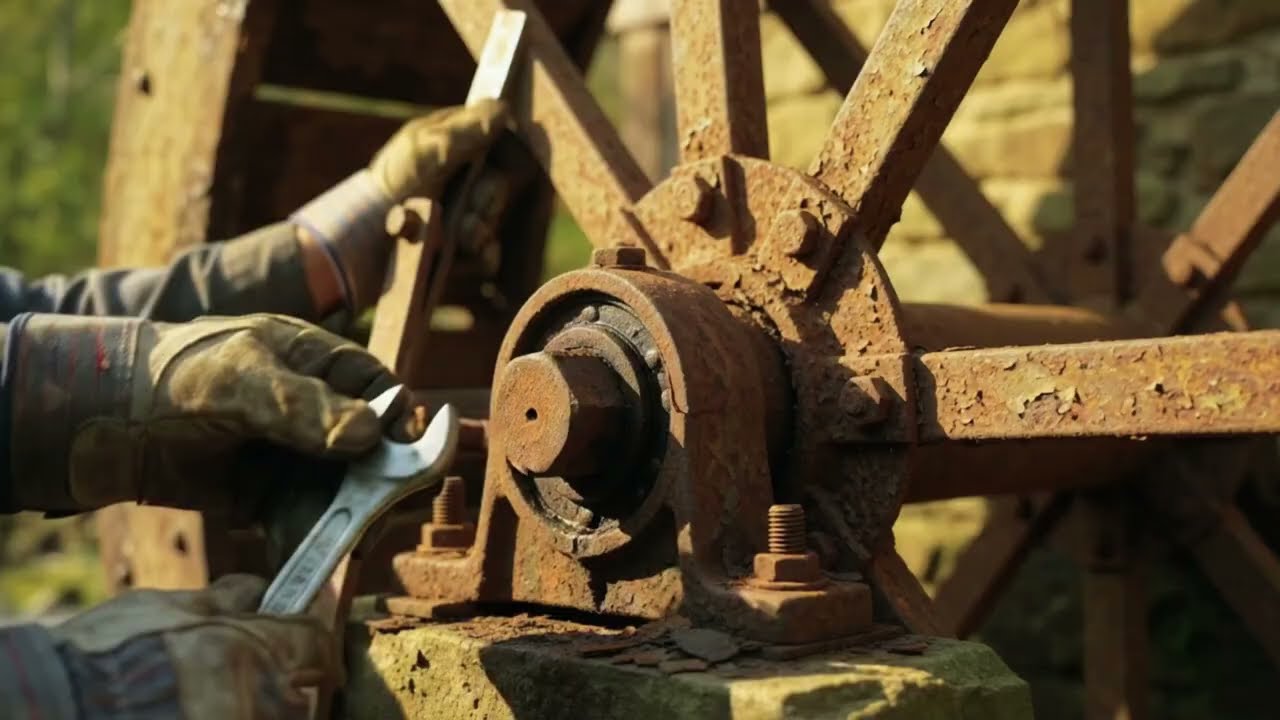
For two weeks, Jack and Sarah excavated the silted tailrace, shoveling out tons of river gravel to lower the water level beneath the wheel housing. Jack disassembled the rusted, seized iron hub, cleaning the heavy four-inch forged steel axle using wire wheels mounted on angle grinders until the original foundry markings emerged: Tredegar Iron Works, Richmond, 1872.
The wooden wheel buckets—the paddle-like compartments that catch the falling weight of the water—had completely dissolved decades ago.
Working from period technical drawings he had obtained from the state historical commission, Jack milled seventy-two identical curved oak buckets from dense, rot-resistant red cedar. Sarah treated each bucket with three coats of non-toxic marine tung oil, bolting them to the iron outer rims with heavy stainless-steel carriage bolts.
Meanwhile, Jack engineered the mechanical link.
Behind the heavy stone wall inside the lower turbine room, he cleaned and lubricated the massive nine-foot cast-iron spur gear—the great bull wheel that translated the slow, powerful rotation of the waterwheel into high-velocity rotational energy. To this historical drive train, he coupled a modern, sealed permanent-magnet low-RPM alternator connected to a lithium-iron-phosphate battery bank and a pure sine-wave inverter mounted in a dry utility vault.
The day of the water release arrived under a crisp, cloudless winter morning.
The frost glistened like crushed diamonds across the hemlock needles. Standing atop the stone intake gate sixty yards upstream, Jack placed his heavy iron spanner onto the sluice gate mechanism.
“Sarah!” Jack called out across the gorge. “Pull the safety pins on the axle lock!”
Down at the wheelhouse, Sarah knocked the steel locking wedges free with a framing hammer. “Clear, Jack! The axle is free!”
Jack turned the iron wheel. With a groaning screech of aged gears, the heavy oak headgate lifted six inches out of the riverbed.
A roaring torrent of crystal-clear mountain water surged into the wooden flume. It raced down the elevated timber trough, gathering speed and weight, until it leaped across the apron and poured into the top buckets of the great cedar wheel.
For five agonizing seconds, nothing moved. The sheer weight of the river fought against the inertia of forty years of rusted silence.
Then, deep within the stone foundation, a sound resonated that made the hair on Sarah’s arms stand straight up.
Groan… creak… shudder.
The massive, twelve-foot cedar wheel shifted forward two inches. A cascade of water spilled over the rim.
Then it moved again. Creak… clack… roll.
With an effortless, majestic momentum, the waterwheel began to turn.
One revolution. Two revolutions. Ten revolutions per minute.
The heavy oak buckets scooped the water, lifted it, and discharged it into the tailrace with a deep, rhythmic, hypnotic splashing that echoed through the entire valley like the steady heartbeat of a waking giant.
Inside the turbine room, the massive iron gears engaged with a muffled, well-oiled hum. In the utility closet, the cooling fans of the electronic inverter kicked on with a soft whine.
Through the windows of the great hall, every single interior light fixture suddenly illuminated—blazing bright, warm, and golden, powered entirely by the clean, unstoppable current of Blackwood Creek.
Lily ran out onto the timber balcony overlooking the wheel, clapping her hands and shrieking with delight as the cool spray misted her face. “Mommy! The river is singing to our house!”
Sarah leaned against the massive stone doorframe, her hand pressed against the vibrating oak lintel. She looked at Jack, who walked down the gravel bank, wiping water spray from his beard, his gray eyes shining with an emotion he couldn’t hide.
“You gave us more than a house, Jack,” Sarah choked out, stepping forward and throwing her arms around his neck, burying her face in the warm canvas of his jacket. “You gave us our lives back. You gave us hope.”
Jack’s arms closed around her, holding her tightly against his chest, his voice rough and thick with a quiet, fierce tenderness. “You both deserved a beautiful new beginning, Sarah. You always did.”
The Sanctuary Realized
Over the next twelve months, the abandoned watermill transformed from an emergency survival camp into an architectural masterpiece that became legendary throughout the region.
The interior layout was designed around the raw, breathtaking beauty of the original industrial architecture.
On the ground floor, the open-concept great room featured soaring fifteen-foot ceilings supported by the exposed white oak posts and hand-hewn chestnut beams. The massive fieldstone hearth was fitted with a high-efficiency cast-iron wood-burning insert capable of heating the entire three-story structure. The kitchen was constructed along the northern stone wall, featuring custom cabinets crafted by Jack from the salvaged nineteenth-century heart-pine floorboards, accented with honed soapstone countertops quarried in the next county.
A custom open-tread staircase made of black iron and solid three-inch oak slabs ascended to the second floor, where Sarah’s master suite overlooked the cascading rapids through an eight-foot floor-to-ceiling structural glass wall.
Lily’s bedroom occupied the sunny eastern corner, where the morning sun poured through multipaned timber windows, complete with a built-in loft bed that Jack carved to resemble the wheelhouse of a ship, complete with a functional cedar steering wheel.
The third floor, nestled beneath the dramatic geometry of the gambrel roof, became Sarah’s professional workspace.
Having resigned from her dead-end administrative role in the suburbs, Sarah leveraged her background in botanical research and agricultural marketing to establish Blackwood Mill Botanicals. Utilizing the pure, mineral-rich spring water that bubbled from the limestone aquifers behind the mill, she developed an organic line of small-batch herbal soaps, essential oils, and stone-ground culinary flours.
The hydro-electric turbine generated a permanent surplus of five kilowatts of clean power, allowing her to run commercial drying kilns, packaging machinery, and digital operations with zero municipal utility overhead.
The once-terrifying wilderness had become an unassailable fortress of peace.
The Confrontation at the Gate
The world outside the hollow, however, does not always leave resurrected lives in peace.
On a brilliant, crisp autumn morning exactly two years after Sarah had been cast onto the suburban driveway, the crunch of gravel heralded the arrival of a vehicle that had no business on Blackwood Creek.
Sarah was standing on the gravel apron beside the roaring waterwheel, adjusting the tension on a secondary flour-mill drive belt, when a late-model luxury European sedan crept down the steep access road, its low-clearance chassis scraping uncomfortably against the gravel ruts.
The car stopped beside Jack’s flatbed truck.
The driver’s door opened, and Daniel stepped out.
He was dressed in designer casual clothes, but his posture was tense, his face carrying the haggard, depleted grayness of an executive running out of options. His eyes swept across the property, and for three long, agonizing minutes, he simply stood paralyzed in sheer, uncomprehending shock.
He looked at the towering, immaculate three-story stone facade, restored to a museum-grade finish with deep, clean mortar joints. He looked at the gleaming standing-seam black steel roof, the custom black-iron thermal glass windows, and the pristine gravel courtyard lined with hand-built fieldstone retaining walls and blooming mountain hydrangeas. He looked at the massive, twelve-foot cedar waterwheel churning steadily in the sunlight, powering the warm lights glowing within the great room.
Beside the door stood a carved cedar sign: Blackwood Mill Homestead & Botanicals — Private Property.
Daniel walked forward, his designer loafers crunching on the stone chips. “Sarah?”
Sarah did not flinch. She set down her adjustable wrench, wiped her hands on a clean blue towel tucked into her denim apron, and stood tall. The frightened, broken woman who had wept on his asphalt driveway two years earlier was entirely gone; standing before him was an independent landowner whose hands knew how to fell an oak, seat a tenon, and command a river.
“What are you doing here, Daniel?” she asked, her voice calm, resonant, and utterly devoid of fear.
Daniel swallowed hard, gesturing vaguely toward the breathtaking architecture behind her. “I… I couldn’t believe it. Someone at the county zoning office mentioned that you had pulled commercial and residential occupancy permits for the old family mill. I thought it was a joke. I thought you were living in a trailer.”
He stepped closer, his eyes scanning the windows, catching a glimpse of the soaring cathedral ceilings and soapstone counters inside.
“Sarah… you built this?” Daniel stammered, his voice laced with an oily, desperate awe. “This property is worth seven or eight hundred thousand dollars. The architectural magazines would pay a fortune to feature this.”
“I didn’t build it alone,” Sarah replied coolly. “And its value is none of your concern.”
Daniel rubbed the back of his neck, forcing a practiced, charming smile that once would have manipulated her completely. “Listen, Sarah… things have been rough in town. The housing market softened, my firm downsized, and the suburban house… well, the mortgage payments became completely unsustainable after the variable rates adjusted. I had to list it last week.”
He took another step forward, lowering his voice into a tone of manipulative intimacy.
“I made a mistake that night, Sarah. I was under enormous financial pressure, and I reacted badly. But Lily is my daughter. We’re a family. Look at this place… there’s more than enough room for all of us. We could sell off an acre, consolidate our assets, and—”
“Stop right there, Daniel,” a deep, slow baritone cut through the morning air like a sharpened axe.
Daniel froze.
Stepping out from the heavy timber doorway of the mill was Jack Miller. He wore a clean flannel shirt, his sleeves rolled up to his forearms, carrying a heavy broadaxe he had been honing at the grindstone. He didn’t raise the tool; he simply rested the poll of the axe against a cedar chopping block, stepping forward until he stood half a step beside Sarah, his broad shoulders easily dwarfing the suburban executive.
Jack didn’t shout. His gray eyes pinned Daniel with a cold, clinical disgust that made the smaller man take an instinctive step backward.
“You have sixty seconds to get back into that vehicle, turn around, and clear this gate,” Jack said, his voice flat as granite.
Daniel’s face flushed with indignant rage. “Who the hell are you? This is a private family conversation! I have legal parental rights—”
“Your parental rights were legally severed by default judgment in county family court eighteen months ago when you failed to appear for three consecutive hearings and abandoned all support obligations,” Sarah interrupted, her voice ringing with absolute, legal finality. “The county sheriff holds a certified copy of the permanent protective order. If your tires are not off this gravel in thirty seconds, I will engage the emergency radio inside that door, and the state troopers from the ridge outpost will intercept you before you reach the blacktop.”
Daniel looked from Sarah’s unblinking eyes to Jack’s massive, silent frame, and finally to the heavy stone archway of the mill.
The realization struck him with crushing clarity: there was no backdoor into this sanctuary. There was no crack in the foundation he could exploit. He had cast away a diamond when he thought it was glass, and the fortress they had built was entirely impenetrable to his pathetic vanity.
Without uttering another word, Daniel turned on his heel, climbed into his luxury sedan, and threw the transmission into reverse. The tires sprayed gravel as he executed a frantic, clumsy three-point turn, speeding up the gorge road until the dust cleared and the mountain silence settled back over the creek.
Sarah watched the empty road for a long moment, drawing a deep, cleansing breath of the clean mountain air.
Then she turned to Jack.
Jack didn’t offer a speech about justice. He reached out with his heavy, calloused hand, gently brushed a loose strand of dark hair from her forehead, and smiled.
“The second-floor floorboards are completely dry,” Jack said softly. “Want to help me hang the front porch swing before the sun goes down?”
Sarah took his hand, her fingers intertwining with his rough, strong grip.
“I’d love to, Jack,” she smiled. “Let’s go home.”
Epilogue: The Living Waters
Years later, if you travel deep into the Appalachian ridges along the winding course of Blackwood Creek, you will find a place that seems entirely untouched by the frantic, disposable cruelty of the modern world.
The great cedar waterwheel continues its eternal, rhythmic rotation, splashing cool, crystal water into the green ferns of the tailrace. The fieldstone walls stand as plumb and true as the day the masons laid them, warm with the life of a family that refused to be discarded.
In the village of the hollow, the children gather at the mill on Saturday mornings. They sit on the timber porch steps, eating warm biscuits made from fresh, stone-ground flour, listening to the gentle, hypnotic song of the river.
And high up on the heavy chestnut lintel above the massive oak entrance door, carved cleanly into the ancient grain with a master carpenter’s chisel, are three simple words that tell the entire story of how an abandoned ruin became an everlasting home:
Built On Hope.