“Nobody Wants a Failure in Our Graduation Photos!” My Sister Shoved Me Out of the Family Picture—But She Never Expected What Happened Next!
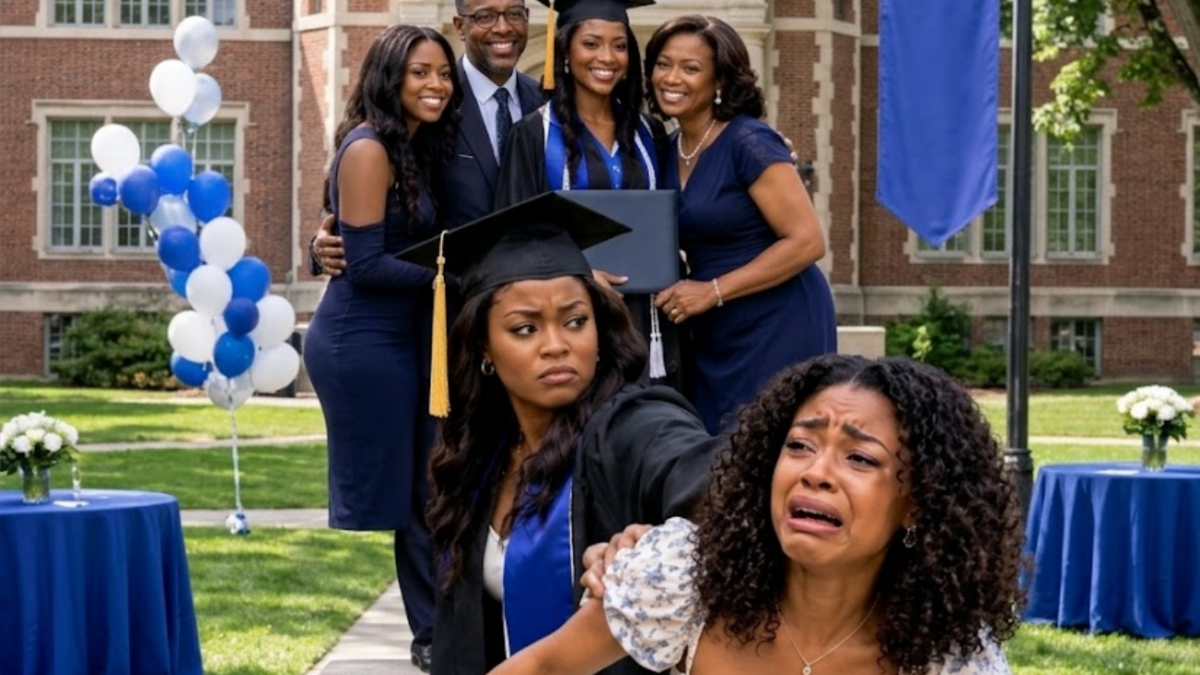
“Nobody Wants a Failure in Our Graduation Photos!” My Sister Shoved Me Out of the Family Picture—But She Never Expected What Happened Next!
Nobody wants a failure in the graduation photos. My sister pushed me out of the family picture in front of our entire family and my own parents watched without saying a word. I stood there wondering how a sister could humiliate someone so easily. Especially when all I wanted was to celebrate her special day.

But what happened minutes later changed everything. When the university dean stepped onto the stage and announced my name, my sister’s smile disappeared. My parents stopped taking pictures. And suddenly the daughter they had spent years calling unsuccessful was the one everyone wanted to hear about.
But why had I kept my biggest achievement a secret? The question I had kept asking myself was simple. How had my own family come to see me as the unsuccessful daughter? To understand that, you have to know what growing up in our house was like. My sister Sloan was always the one everyone noticed.
She was four years younger than me, but somehow her achievements became family celebrations while mine were treated like ordinary responsibilities. When she brought home a good report card, dad would take us all out for dinner. When she won a school competition, mom would call relatives and tell them every detail. I never minded seeing my sister succeed.
What hurt was realizing that the same excitement rarely appeared when something good happened to me. I was never a troublemaker. I studied hard, kept my grades high, and tried to make my parents proud. During my final year of high school, I was accepted into a respected university program focused on architectural design. It was the first time I felt I had a clear direction for my future.
I wanted to design homes that were not only beautiful, but also affordable for ordinary families. I had spent years sketching floor plans in the margins of my notebooks, imagining how small spaces could be made more comfortable and useful. When the acceptance letter arrived, I carried it downstairs and placed it on the kitchen table.
Mom read it, smiled politely, and said it was good news. Dad glanced at the letter before asking whether I had checked the tuition costs. I remember waiting for him to say something more. Instead, he folded the paper and placed it beside the grocery receipts.
At the time, my father, Merritt, was dealing with problems in his construction business. A major project had been delayed and several payments had not arrived when expected. I understood that money was tight. I wasn’t asking for expensive clothes or a new car. I only wanted to know whether my parents could help me get started with university.
Dad told me we would discuss it after things settled down. I believed him because I had no reason to think otherwise. Sloan was still in high school then, and I assumed my parents would try to make room for both of us. But a few weeks later, the conversation changed. Dad explained that the business needed his attention and that paying for my education was no longer possible. He said I was old enough to find another way, perhaps through work or alone.
I asked whether the same rule would apply when Sloan was ready for college. Mom quickly answered that we couldn’t compare the two situations because Sloan’s future plans were different. That answer stayed with me. I didn’t argue even though I wanted to ask what made her plans more important than mine. I applied for financial aid, looked into scholarships, and searched for part-time jobs.
I was willing to do whatever it took, but the deadlines were approaching, and the support I had expected from home was gone. I eventually had to give up my place in the program. I still remember sitting on my bedroom floor with the university documents spread around me, trying to decide which ones I needed to put away. It wasn’t just the disappointment of missing college.
It was the feeling that a future I had worked toward could disappear without anyone in my family treating it as a serious loss. I started working at a small architectural design studio not long afterward. The pay wasn’t impressive and most of my early tasks were basic. I organized drawings, checked measurements, prepared presentation files, and made corrections whenever the senior designers asked. So, I enjoyed being there. I learned how projects moved from an idea to a finished design.
I watched how experienced architects solved problems when a client’s budget was limited or a building site presented unexpected challenges. I kept a notebook where I recorded ideas and questions. Some evenings I stayed late to study designs that interested me. I wasn’t enrolled in the university program anymore, but I refused to let go of the subject completely.
At home, however, my job was often described as a temporary arrangement. Whenever relatives asked about my education, mom would say I had decided to work instead of continuing my studies. She never mentioned that my parents had withdrawn their financial support. Dad usually changed the subject and I learned that correcting them only made family gatherings uncomfortable.
Sloan, meanwhile, was preparing for university. My parents visited campuses with her, helped her compare programs, and discussed tuition as though it were the most natural thing in the world. They bought her a new laptop and paid for a preparation course.
When I asked whether she had received a scholarship, mom said they wanted to make sure Sloan had every possible advantage. I didn’t resent my sister for receiving those things. She hadn’t made the decisions about my education, but I couldn’t ignore the difference. When I had needed help, I was told to manage on my own. When Sloan needed help, the whole household adjusted around her.
At family dinners, dad would ask about her classes, her friends, and her plans after graduation. If I mentioned a design project at work, the conversation often moved on before I could explain it. I began sharing less. It was easier to keep my goals to myself than to watch people lose interest halfway through a sentence.
There was one evening when that difference became impossible to overlook. Sloan had received an academic award during her second year, and my parents hosted a dinner at home. relatives filled the dining room and dad gave a cheerful speech about how proud he was of her. I was genuinely happy for her. I even helped mom arrange the food and set up the decorations before everyone arrived.
Later, one of my aunts asked what I was doing with my own career. Before I could answer, mom said I was still working at the design office and hadn’t made any major progress with my education. A few people nodded sympathetically. I wanted to explain that I was learning every day and had started contributing to real projects, but the moment had already passed.
Sloan was being asked to show everyone her award, and all attention returned to her. I went back to work the following Monday and carried on. I didn’t have a grand plan to prove anyone wrong. I simply knew I still cared about architecture and I wanted to become good enough that my work could speak for itself. The studio gave me opportunities slowly.
A senior designer began asking for my input on smaller housing projects. Then I was trusted with more detailed planning tasks. I made mistakes, corrected them, and learned to defend my ideas with facts instead of taking criticism personally. For the first time, I was building something that belonged to me. My family didn’t know how much effort I was putting into that work. They saw the same daughter who had left university, and they assumed nothing important had changed.
I let them believe that because I was tired of explaining myself. By then, I had learned that being underestimated by my family was painful. But I didn’t have to decide what I could become. And without realizing it, the work I was doing after hours was leading me toward an opportunity none of them would have expected. That opportunity began with a project that looked almost too ordinary to matter.

One afternoon, my supervisor, Mr. Hollis, placed a set of housing plans on my desk and asked me to review them. The project was for a small development intended for families who couldn’t afford large homes, but still needed enough space to live comfortably. The original design was attractive, but the construction costs were too high.
Several features also wasted space that could have been used more effectively. My job was to identify possible changes. But as I studied the plans, I started seeing a bigger problem. Many affordable housing projects were being designed around what developers could build cheaply, not around what families actually needed.
I began making notes about how the rooms could serve more than one purpose without making the homes feel cramped. I looked at ways to improve natural light, reduce wasted hallway space, and make storage part of the design instead of adding it as an expensive extra. I also considered materials that were durable but less costly. I wasn’t trying to create something complicated. I wanted to make a home feel practical and welcoming for someone who had worked hard just to afford it.
I prepared a revised layout and showed it to Hollis, expecting him to point out a dozen problems. Instead, he studied it carefully and asked me to explain why I had moved certain walls and changed the room arrangements. We spent nearly an hour discussing the design. Before leaving, he told me there was a strong idea in my work and that I should develop it further.
That was the first time someone outside my family had treated one of my ideas as something worth exploring. I took the project home and continued working on it. After my regular hours, I tested different layouts, compared material costs, and made several versions before I was satisfied.
Some designs looked good on paper, but became impractical when I considered actual construction limits. Others saved money, but made the living spaces uncomfortable. I had to find a balance. There were nights when I sat at my desk until well after midnight, looking at the same measurements and wondering whether I was missing something obvious. Still, I kept going because the problem mattered to me.
I knew what it felt like to have a future narrowed by circumstances outside your control. The idea that better housing could make life a little easier for working families gave the project a purpose beyond my career. A few weeks later, Hollis told me about a national innovation program that accepted practical design proposals.
The program supported ideas that could improve communities, especially projects connected to housing, public spaces, and everyday living conditions. He thought my work might be suitable. I hesitated because I wasn’t a university student, and I had no idea whether an independent designer from a small studio would be taken seriously. Hollis told me that the selection panel would judge the proposal on its quality and usefulness, not on how impressive the applicant’s background looked. He offered to review my submission before I sent it.
I spent the next several weeks preparing the application. I wrote about the housing problem, explained my design choices, included cost comparisons, and added drawings showing how the homes could be built. I also included the changes I would make after testing the design with construction professionals.
Submitting the application was harder than I expected. I had to explain technical ideas in clear language and show that the design could work outside my own drawings. I contacted people in the industry, asked questions, and checked my calculations repeatedly. One contractor pointed out that a material I had selected might not be easy to source in every region. I went back and found another option.
A designer questioned whether one of my storage solutions would remain practical for a family with young children. I adjusted it. Each comment forced me to look at the project from another angle. By the time I submitted the final version, I knew it was much stronger than the first design I had shown Hollis. Then came the waiting. The program received applications from universities, design firms, and independent teams across the country.
I tried not to think about it too much. I continued working at the studio and helped with other projects. But every time an email arrived, I checked it carefully. Weeks passed without an update. I began telling myself that even if I wasn’t selected, the experience had taught me something useful.
I had developed a complete proposal, learned how to present my work, and received feedback from people whose opinions I respected. That was already more than I had expected when I first started sketching housing layouts in my notebook. One afternoon, I received an email asking me to attend an online interview with the selection panel. I read it twice before believing it.
The interview was scheduled for the following week. I prepared a short presentation and practiced explaining the project without rushing. When the panel asked how I would make sure the design remained affordable during construction, I walked them through the material choices and layout changes. One member asked whether I had considered how the homes could be adapted for families whose needs changed over time.
I explained how certain rooms could serve different purposes and how the basic structure allowed for practical adjustments. I didn’t know whether my answers were good enough, but I left the interview feeling that I had finally been given the chance to discuss my work on its own merits. About a month later, my phone rang while I was at the studio.
It was a representative from the innovation program. She told me that my proposal had been selected for a national recognition award and that I had also been approved for a research grant to develop the design further. For a moment, I couldn’t answer.
I asked her to repeat the announcement because I was afraid I had misunderstood. She confirmed the result and explained that the panel had been impressed by the project’s practical approach to affordable housing. The grant would help me test the design, work with housing professionals, and prepare it for possible use in future developments. When I ended the call, I sat quietly at my desk. I didn’t jump up or announce it to everyone in the office.
I simply looked at the drawings on my screen and thought about the girl who had once packed away her university acceptance letter because her family couldn’t support her education. I wished I could tell that younger version of myself that losing one opportunity didn’t mean every opportunity was gone.
Hollis noticed my expression and asked whether something had happened. When I told him, he stood up, came around my desk, and congratulated me. He said the recognition was deserved and that I should be proud of the work behind it. I thanked him, but I was still trying to take it all in. The program had a partnership with my former university, and the organizers explained that the award would be formally presented during an upcoming university ceremony.
The timing was unusual because the university was also holding its graduation celebrations that week. They plan to include a short recognition segment for selected community innovation projects, and the dean would personally announce the recipients. I was sent an official invitation with the details. When I saw the university name, I thought about the program I had once been forced to leave.
I had no idea that I would be returning to that same campus for a reason completely different from the one I had imagined years earlier. Sloan’s graduation ceremony was scheduled for the same day. My parents had been talking about it for months, and they were especially excited because relatives were coming from out of town. When the invitation arrived, I realized I could attend both events without telling anyone about my award beforehand.
Part of me wanted to share the news immediately. I imagined calling mom and hearing her say she was proud of me. I imagined dad asking to see the project and wanting to understand how it worked. But I also remembered the way they had treated my earlier ambitions. And I wasn’t ready to turn something important to me into another family discussion about whether my achievement was impressive enough.

So, I kept the invitation private. I told my parents I would be attending Sloan’s graduation just as they expected. I didn’t explain that the university had also invited me to receive an award. I wanted to experience that moment without wondering whether my family approved of it. I wanted to walk onto that stage knowing I had earned my place there through my own work.
As the ceremony approached, I received confirmation of the presentation schedule and the final instructions from the university. I checked my clothes, made sure I had the required documents, and reviewed the short remarks I planned to give. I was nervous, but it was a good kind of nervous. For once, I wasn’t preparing to defend my choices to my family. I was preparing to stand in front of people who had judged my work fairly. I still didn’t know how my parents would react when they heard my name.
I didn’t know whether Sloan would be happy for me or see the announcement as a threat to her special day. All I knew was that I had spent years being introduced as the daughter who had failed to finish university. Soon I would be standing inside that same university, not as a student receiving a degree, but as an independent designer being recognized for work I had built from the ground up.
By the time graduation morning arrived, I had already checked my award invitation more times than I could count. I placed it carefully inside my handbag along with my identification and the documents the university had requested. Then I chose a simple navy blue dress and a matching jacket. I wasn’t attending as a graduate and I didn’t want to dress as though I were trying to compete with Sloan.
I was there to celebrate her achievement just as I had promised my parents. Still, I couldn’t ignore the strange feeling of returning to the campus where I had once hoped to study. The buildings looked familiar, but I was walking through them with a completely different purpose. My parents had arranged to meet outside the main entrance.
Dad was wearing a dark suit and mom had chosen an elegant cream dress. Sloan arrived in her graduation gown, holding her cap and smiling as relatives gathered around her. Everyone wanted photographs. My aunt asked her to stand near the university sign while dad adjusted his phone to get the right angle. Mom kept fixing Sloan’s gown and reminding her to hold her head up.
I stood a little to the side, waiting until they finished. I was happy for my sister, but I also felt like an extra person in a celebration where every detail had been planned around her. When the family began arranging a group photograph, I moved closer. My mother was standing beside Sloan.
Dad was on her other side, and two relatives were trying to fit into the frame. I stepped toward the open space near the edge. Before I could settle into position, Sloan looked at me and frowned. She glanced at my outfit, then at the camera as though my presence had ruined the picture she wanted. I assumed she was going to ask me to move slightly. Instead, she reached out, pushed me away from the group, and said loudly, “Nobody wants a failure in the graduation photos.” For a second, I couldn’t move.
I heard a few people stop talking. One cousin lowered his phone, and my aunt looked from Sloan to me with an uncomfortable expression. I waited for my mother to correct her. I waited for dad to tell Sloan that she had gone too far.
But mom simply adjusted the edge of her daughter’s gown and said that we should hurry because the ceremony was about to begin. Dad looked at me and quietly told me not to make a scene on such an important day. I hadn’t said a word yet. Somehow I was being treated as the person who might ruin everything. I stepped away from the group.
I didn’t want to argue in front of the relatives or turn Sloan’s graduation into a family fight. But what she had said was not new. It was simply the first time she had said it so openly. For years, my family had used my unfinished education as a reason to measure my worth. Now, standing outside the university, my sister had turned that judgment into a public insult.
I walked toward a quieter area near the entrance and took a breath. My handbag was still on my shoulder, and the award invitation was inside it. I could feel the folded paper against my hand when I reached for my phone. A few minutes later, the university staff began directing guests toward their seats. I followed the signs to the section listed on my invitation.
My parents and relatives were seated together while I took a seat a few rows away because the award recipients had been asked to remain near the front. Sloan was with the graduating students taking her place among her classmates. From where I sat, I could see my father leaning toward my mother and pointing at the stage. They were excited, and I didn’t blame them for that.
Their daughter was graduating. It was an important day. I only wish they had understood that someone else’s success did not make mine less meaningful. The ceremony began with the usual welcome from the university staff. The dean spoke about the students hard work, the support of their families, and the responsibilities that came with completing a degree. I listened quietly.
When Sloan’s name was called, my parents stood and applauded with the relatives. Dad held up his phone to record her crossing the stage. Mom had tears in her eyes. I clapped, too. Whatever had happened outside, I wasn’t going to pretend that Sloan hadn’t worked for her degree. I wanted her to have that moment.
After the graduates had returned to their seats, the dean stepped back to the microphone. He explained that the university had invited representatives from a national innovation program to recognize work that was making a practical difference beyond the classroom. I straightened in my seat. This was the part of the ceremony I had been waiting for.
The dean spoke briefly about the value of ideas that addressed real problems and about the importance of giving independent professionals a chance to develop useful solutions. Then he began describing the affordable housing project selected for national recognition. He mentioned the designs focus on making smaller homes more practical, reducing unnecessary construction costs, and improving everyday living conditions for families.
As he spoke, I recognized the details from my own proposal. My hands tightened around the program in my lap. The dean then announced that the project had received the innovation award along with a research grant to support its next stage of development. He paused before reading the recipient’s name.
Please join me in welcoming Fallon. For a moment, the sound of the applause seemed to come from very far away. Then I stood. I could see my parents turning toward the stage, their expressions changing as they realized the dean had called me. Sloan was looking in my direction too. Her smile had disappeared. I walked toward the steps trying to keep my movement steady. The dean greeted me with a handshake and presented the award.
A university representative handed me a folder containing the formal recognition and grant information. Cameras began flashing and the audience applauded as I stood beside the dean. He said a few words about my work and explained that I had developed the proposal while working independently in the architectural design field. He also mentioned that the selection panel had recognized its potential to help families who needed affordable, well-planned homes.
Hearing those words in that room meant more to me than I could easily explain. I wasn’t receiving a degree and I wasn’t being presented as a university graduate. I was being recognized for work I had created after leaving the education path my family had once considered my only chance at success.
When the dean invited me to say a few words, I stepped toward the microphone. I thanked the program, the selection panel, and the people who had taken the time to review and challenge my work. I thanked Hollis for encouraging me to develop the idea instead of dismissing it as an ordinary design exercise. I explained that affordable housing was important because a home should give people stability, not become another source of financial pressure. I kept my remarks brief.
I didn’t mention my family or the years I had spent feeling underestimated. This achievement did not need an explanation of who had doubted me. As I finished, the applause grew louder. I looked across the audience and saw my parents still watching me. Dad had lowered his phone.
Mom’s hands were resting in her lap, and she seemed unsure whether to smile. Sloan was sitting among the graduates, staring toward the stage. I couldn’t tell exactly what she was thinking, but I could see that the announcement had caught her completely offguard. The university photographer asked me to stand with the dean for another picture. I held the award in front of me while the cameras captured the moment.
It was a simple photograph, but I knew I would remember it for a long time. Earlier that morning, my sister had pushed me out of a family picture because she believed I had nothing worth celebrating. Now, I was standing on the university stage because a panel of people had judged my work and decided it deserved recognition.
When I returned to my seat, several people nearby congratulated me. One woman asked about the housing design and another wanted to know how the grant would support the next stage. I answered their questions as best I could. For the first time that day, I wasn’t being treated as someone who needed to stay out of the frame.
People were interested in what I had done. The ceremony continued, but I could feel my family’s attention on me whenever I looked in their direction. My phone began to vibrate with messages from relatives who had just discovered what the announcement meant. I didn’t check them immediately. I wanted to stay present and enjoy the recognition without turning it into another family discussion.
When the ceremony finally ended, I collected my documents and made my way toward the main hall. My parents were already waiting near the exit. Mom reached me first and looked at the award in my hands. Fallon, why didn’t you tell us? She asked. Dad stepped closer, still looking surprised. Before I could answer, Sloan approached from behind them, her graduation gown moving as she walked.
She looked at the award then at me and said, “You really chose today to announce this?” I looked at her for a moment. She had spent the morning making sure I understood that this was her day. Now that the dean had called my name, she seemed more concerned about the attention I had received than about what I had achieved. I could have reminded her of what she had said outside the entrance.
I could have asked why she thought pushing me out of a photograph was acceptable, but I decided not to argue in the hallway. I simply held the award close and answered, “I didn’t announce anything, Sloan. The university did.” My answer left Sloan with nothing to say for a moment. Mom looked between us, then reached toward the award as though she wanted to examine it more closely. This is wonderful, Fallon. A national award and a research grant.
Why would you keep something like this from your own family? Her voice sounded warm, but I noticed that she hadn’t asked a single question about the project itself. Dad joined in saying he wished I had told them earlier so they could have shared the excitement with me. I looked at both of them and wondered whether they remembered the last time I had shared something important.
When I brought home my university acceptance letter, they had barely discussed it. When I lost that opportunity, they had told relatives I had chosen work instead. Now they were asking why I hadn’t trusted them with good news. I wanted to be certain before I told anyone.
I said the application process took months and I didn’t want to make an announcement before the result was official. It was a reasonable answer, but dad didn’t seem satisfied. He said parents should be the first people to know about their children’s achievements. I almost laughed at the irony, but I held back. I didn’t want to turn the conversation into a list of every time they had overlooked me. I wanted them to understand that keeping the award private hadn’t been an attempt to hurt them.
It had been my way of protecting something I had worked hard to achieve. Sloan folded her arms. You could have told us before the ceremony. you knew everyone was coming to celebrate my graduation. I looked at her and asked, “Would you have been happy for me?” She immediately said that of course she would. But her expression told a different story.
I reminded her that only a few minutes earlier she had pushed me away from the family photograph and called me a failure. Her face tightened. She said she had been joking and that I was taking a comment too seriously. I told her it hadn’t sounded like a joke when she said it in front of our relatives.
Mom quickly interrupted, saying we shouldn’t argue because it was supposed to be a happy day. Once again, the person who had been insulted was being asked to make things comfortable for everyone else. Dad suggested that we go somewhere quiet and talk after the ceremony. I agreed because several relatives were still nearby and I didn’t want a public argument. We moved to a quieter part of the university hall. My aunt approached first and congratulated me.
She asked how long I had been working on the housing design and whether I would continue developing it. I explained that the grant would allow me to test the proposal and work with professionals who understood construction and community housing. She listened carefully and said she had no idea I had been doing such important work.
Then she turned toward my parents and asked how they had managed to keep the news a secret. Mom gave a small uncomfortable smile and said they had only just found out themselves. That comment made me realize how much my parents had misunderstood the situation. They hadn’t been part of the process because they had never shown much interest in what I was building.
I had learned not to bring my work home because conversations about it usually ended quickly. Now surrounded by relatives who wanted to know more, my parents were trying to present themselves as surprised but supportive. I didn’t correct them in front of everyone.
I answered the questions, people for their congratulations, and kept the conversation focused on the project. After a while, Dad asked me to step outside with him. Mom and Sloan followed. He began by saying that the family was proud of me and that we should all celebrate together. I told him I appreciated the congratulations, but I needed him to understand why I had kept my achievement private.
I reminded him of the day my university acceptance letter arrived. I had asked for help, not a guarantee that everything would be paid for without question. I had been willing to apply for financial aid, work part-time, and contribute whatever I could, but he had decided that my education was something I needed to manage alone. Then, when Sloan went to university, the family found money for her laptop preparation courses, and other expenses.
Dad looked uncomfortable. He said the business had been struggling at the time, and that he had made the best decision he could with the money available. I understood that his business had faced difficulties. What I couldn’t understand was why he had never been honest about the difference in how he treated us.
He could have told me that the family could not afford to support both of us. He could have helped me explore other options or at least acknowledged how much it hurt to give up my place. Instead, he had allowed everyone to believe that I simply lacked the discipline to continue studying. Mom said I was being unfair because they had never wanted me to fail. I asked her why she had told relatives that I chose not to continue my education.
She looked away and said she didn’t want people asking uncomfortable questions about the family’s finances. I told her that protecting the family’s image had meant letting everyone judge me for a decision I hadn’t freely made. She replied that I should have corrected people myself. That answer hurt more than I expected. I had been the one who lost the opportunity.
Yet I was also expected to carry the responsibility for explaining their choices to everyone. Sloan interrupted and said that her education had required sacrifices too. I agreed. She had worked hard for her degree and I had never claimed otherwise, but she seemed unable to accept that both of us could deserve recognition. She said the ceremony had been planned around her graduation and my announcement had taken attention away from her.
I reminded her that I hadn’t chosen the date of the award presentation. The university had arranged it as part of its innovation recognition program. I had simply accepted the invitation. You could have asked them to present it another day, she said. I looked at her in disbelief. Why should I turn down an achievement I earned because you might not want to share the attention? She didn’t answer.
Instead, she said that I always found a way to make things about myself. I thought about the family photograph, the insult, and the way she had reacted when the dean called my name. I finally understood that the problem wasn’t the timing of the award.
Sloan had become accustomed to being the person everyone celebrated, and she didn’t know how to respond when someone else received attention. For a moment, none of us spoke. Then, Dad changed the subject and asked what I planned to do with the grant. I explained that it was intended for research and development, not personal spending. The next stage would involve testing the design, collecting feedback, and working with people who could help assess whether the proposal was practical for different communities.
He nodded and said it sounded like a promising opportunity. Then he asked whether the program might offer other professional opportunities in the future. I told him it was possible depending on the results of the research and the needs of the program. That was when Sloan’s attitude changed. She asked whether I could introduce her to the people who had selected my project.
She was interested in finding a position connected to the foundation or its partner organizations. She said a recommendation from me could help her get noticed, especially now that the dean knew my name. I asked her whether she had already looked into the available positions. She said she had searched online but hadn’t found anything suitable. Then she explained that she was hoping I could speak to someone directly and help her get an interview.
I told her I could share public information about the program, but I wasn’t going to ask anyone to give her special treatment. She immediately looked offended. “You’re making it sound like I’m asking for something wrong,” she said. I answered that there was nothing wrong with applying for a job, but a professional opportunity had to be earned. My award didn’t make me responsible for arranging her career.
Mom stepped in and said that helping your sister was a normal thing to do. I agreed that helping was normal, but there was a difference between giving someone useful information and using a professional relationship to secure an advantage they hadn’t earned. I had worked for months to develop my proposal, answer difficult questions, and convince the panel that my work deserved support. I wasn’t going to treat the people who had trusted me as though they owed my family a favor.
Sloan said I was acting superior because I had received an award. I told her that wasn’t true. I was simply setting a boundary. She could apply for any suitable position and I would never try to stop her, but I wouldn’t promise her a recommendation based only on our family relationship. She turned toward mom, expecting her to support her, but mom stayed quiet.
Dad looked at his watch and suggested that we stop discussing it because everyone was tired. Before we separated, I told them there was something else I needed them to understand. I was happy to celebrate Sloan’s graduation, but I would no longer accept being introduced as the family failure. I had taken a different route after leaving university.
That route had been difficult, but it had led me to meaningful work. I didn’t need them to pretend they had supported every step. I only expected them to stop rewriting my story to make themselves look better. Dad said nobody had ever called me a failure.
I reminded him that he had heard Sloan say it outside the entrance and had told me not to make a scene. He didn’t respond. Mom said she would speak to Sloan about the photograph, but I told her that an apology would need to come from Sloan herself. I wasn’t asking for a public argument or a dramatic family announcement. I wanted the person who had humiliated me to take responsibility for what she had done. That evening, I returned home with the award and the grant documents.
I placed them on my desk beside the drawings I had worked on for months. I didn’t post a family photograph or write a long message about proving people wrong. I simply looked at the recognition certificate and allowed myself to feel proud. The day had been far from perfect, but the most important part had already happened.
My work had been recognized and I had finally stopped asking my family to decide whether that recognition mattered. Over the following days, relatives continued sending messages. Some apologized for believing the story that I had abandoned my education by choice. Others asked for details about the award.
I answered politely, but I didn’t turn every conversation into an explanation of my parents’ behavior. I also began planning the next stage of the housing project. There were meetings to arrange, research expenses to review, and professionals to contact. My attention needed to be on the opportunity one had earned. A few days later, Sloan sent me a message. First, it was brief. She said she hadn’t meant to embarrass me and that she was upset because the ceremony was important to her. I read it carefully.
It wasn’t quite an apology, but it was the first time she had acknowledged that her words had hurt me. I replied that I understood the day mattered to her, but that didn’t excuse pushing me away or calling me a failure.
I told her I was willing to have a proper conversation when she was ready to take responsibility without blaming me for the attention I had received. She didn’t reply immediately. I didn’t chase her for an answer. For years, I had been the one trying to keep the family comfortable, explaining myself, and accepting less so that nobody else would feel challenged. I wasn’t going to return to that pattern just because the ceremony was over. My parents also called a few times.
Dad asked about the research schedule, and mom wanted to know when I would hear more from the foundation. I answered their questions, but I kept the conversations honest and limited. I didn’t pretend that one afternoon had repaired years of unequal treatment. Their congratulations were welcome, but trust would take more than a few kind words.
The biggest change was that I no longer felt the need to convince them that my life was moving forward. I had a project to develop, a grant to use responsibly, and a career I was building through my own decisions. My sister had graduated that day, and I was genuinely glad she had reached her goal. But her achievement did not cancel mine, just as mine did not take anything away from her. For the first time, I could see the family photograph incident clearly.
Sloan had pushed me out because she believed my presence made her look better by comparison. My parents had allowed it because they were used to protecting her feelings before considering mine. But the dean’s announcement had shown something none of them could change. My worth had never depended on whether my family chose to recognize it.
I didn’t need revenge that involved ruining my sister’s future or embarrassing my parents in front of everyone. The consequence was much simpler. I stopped accepting the role they had assigned me. I would celebrate my sister when she deserved it, but I would no longer make myself smaller to keep her comfortable.
And when my work called me forward, I would walk toward that opportunity without waiting for anyone in my family to give me permission.
The granite portico outside the university’s grand commencement auditorium was awash in the blinding glow of morning sun, surrounded by families gathering for celebratory portraits. Velvet ribbons, gold-tasseled mortarboards, and bouquets of fresh hydrangeas crowded the lawn, creating a festive tapestry of pride and achievement. For four years, this particular morning had been anticipated by the Mercer family as the crowning achievement of their domestic narrative—the day their younger daughter, Sloan, walked across the stage to receive her degree in communications and public relations.
Fallon Mercer stood on the periphery of the manicured lawn, smoothing the lapels of her modest navy-blue jacket. She had driven three hours across the state line to be here, taking an unpaid day off from her job at a local architectural design studio. She carried no bouquet, and her name appeared nowhere in the commencement program, yet she had arrived with genuine warmth in her chest, determined to bear witness to her sister’s milestone.
“Sloan, over here by the stone archway! The lighting is perfect!” their mother, Evelyn Mercer, called out, waving a silk scarf to herd the arriving relatives. Uncles, aunts, and second cousins from out of town gathered eagerly, adjusting neckties and raising camera phones.
Merritt Mercer, a prominent commercial building contractor whose broad shoulders and booming voice had commanded construction sites for three decades, stepped to the center of the lawn. He held up his digital camera, orchestrating the family lineup with theatrical authority.
“Alright, everyone together!” Merritt boomed, his face flushed with paternal pride. “Grandparents in the front, aunts and uncles flanking. Sloan, right in the center with your diploma binder! Evelyn, get right beside her!”
The crowd shifted into position. Fallon noticed an open space on the right flank, just beside her mother and sister. Stepping forward carefully so as not to tread on her cousin’s dress shoes, Fallon moved toward the edge of the frame, ready to smile for the portrait.
She never made it into the shot.
Sloan turned abruptly. Her manicured hands shot forward, planting themselves firmly against Fallon’s shoulders with enough force to send Fallon staggering backward across the brick border of the flower bed.
The impact was sharp, but the words that followed cut through the ambient chatter of the courtyard like a serrated blade.
“Get out of the shot, Fallon!” Sloan snapped, her voice carrying across the lawn with piercing clarity. “Nobody wants a failure in the graduation photos!”
The laughter around them died instantly. A cousin holding a smartphone lowered the device, his eyes darting between the sisters. An aunt took a sudden half-step backward, her hand flying to her mouth in startled embarrassment. Dozens of surrounding families turned to look, drawn by the raw, public violence of the insult.
Fallon stood frozen, her heels digging into the mulch, her breath caught in her throat. Her eyes locked onto her mother, waiting for the reflexive maternal defense that any wronged child expects. She waited for Evelyn to reprimand Sloan for the cruelty, or for her father to lower his camera and demand an immediate apology.
Neither occurred.
Evelyn merely leaned down, smoothed a wrinkle from the satin hem of Sloan’s black graduation gown, and murmured, “Come now, girls, let’s keep moving. The procession starts in twenty minutes and we don’t want to lose our seats.”
Merritt didn’t even lower the lens. He glared at Fallon over the top of the camera body, his voice dropping into a harsh, hushed reprimand. “Fallon, don’t stand there sulking and make a scene. This is your sister’s morning. Stand off to the side if you can’t compose yourself.”
Not a single relative spoke. The collective silence of the family closed around Sloan like a protective shield, casting Fallon into the cold perimeter.
Fallon drew a slow, agonizing breath of the morning air, feeling the familiar, suffocating weight that had defined her existence within the Mercer household for nearly a decade. She nodded once—not in submission, but in a strange, clarifying moment of absolute emotional detachment.
“I won’t ruin your picture,” Fallon whispered.
She stepped away from the lawn, turning her back on the smiling family as Merritt’s camera clicked repeatedly, immortalizing a portrait of perfection built upon the deliberate erasure of his eldest daughter.
Walking toward the side entrance of the auditorium, Fallon reached into her handbag. Her fingers grazed the crisp, heavy parchment of a cream-colored envelope bearing the university’s embossed gold seal and the signature of the Dean of Academic Innovations.
She felt no urge to scream, no desire to retaliate with bitter words. She simply held the leather strap of her purse, walked through the heavy oak doors of the auditorium, and took her seat in the reserved front rows—a designated guest of the university administration, waiting for a clock that was ticking down toward an inevitable, public reckoning.
The Blueprint of Inequality
To understand the casual cruelty of that morning on the university lawn, one had to examine the hidden architecture of the Mercer household—a home where love was treated not as an unconditional foundation, but as a scarce, competitive currency allocated entirely on the basis of social prestige.
Growing up, the disparity between the two sisters had not been born of malice, but of calculated convenience. Sloan, four years younger, was born with the effortless charisma of an extrovert. She had a bright, performative charm that played well at rotary club dinners, construction trade galas, and suburban family reunions. Her achievements, no matter how minor—a middle school ribbon for track, a role in an amateur theatre production, a standard honor roll certificate—were treated as major civic events. Merritt would take the extended family out for prime rib dinners to toast her brilliance, while Evelyn spent hours on the landline, providing breathless recaps to relatives across three counties.
Fallon, by contrast, was an introvert whose passion did not lend itself to easy dinner-table spectacle. From the age of twelve, while other children were watching television, Fallon sat at an old draftsman’s desk in the basement, sketching intricate, three-dimensional architectural plans in the margins of her notebooks. She was fascinated by space, structure, and human geography. She drew modest single-family dwellings, studying how cross-ventilation could lower utility costs for working-class tenants, and how modular interior walls could allow a growing family to reconfigure a compact footprint without taking on crippling debt.
Her academic record was impeccable. She graduated near the top of her high school class, keeping her head down, avoiding drama, and working part-time at an art supply shop to pay for her own drafting pens and design software.
The fracture point arrived during the spring of her senior year of high school.
An oversized envelope arrived in the mail, bearing the insignia of the state’s premier architectural design program—a highly competitive, five-year accredited track that admitted fewer than sixty students nationwide per year. Fallon had earned a direct acceptance based on her design portfolio.
She remembered running down the wooden stairs into the kitchen, her heart hammering against her ribs with pure, unadulterated joy. She placed the acceptance letter on the table between her parents.
“Mom, Dad, look,” Fallon had said, her voice trembling. “They accepted my portfolio. The housing design track.”
Evelyn had picked up the letter with two fingers, scanned the opening lines with a polite, distracted smile, and murmured, “That’s very nice, dear. Architecture is a respectable field.”
Merritt had picked up the fee schedule enclosed with the letter. His eyes drifted over the tuition figures, housing fees, and material expenses. Without looking at the designs Fallon had spent three years compiling, he folded the document, laid it flat beside the grocery coupons on the kitchen island, and reached for his coffee mug.
“Tuition is steep,” Merritt had grunted. “Design school isn’t like a business degree. It’s a lot of overhead for a piece of paper. We’ll talk about how to handle this after the construction season gets rolling.”
Fallon had trusted him. At eighteen, she had no reason to believe that a father’s word was anything less than a binding contract.
At the time, Merritt’s contracting business was experiencing cash flow disruptions. A commercial strip mall project had stalled due to permit delays, and several subcontractor invoices had arrived simultaneously. Fallon understood that sacrifices had to be made. She didn’t ask for a new car, she didn’t request an allowance for campus clothes, and she offered to work twenty hours a week in the university cafeteria to offset her board.
Three weeks later, the final enrollment deposit was due. Fallon entered her father’s home office, holding the invoice and a pen.
Merritt had sat behind his desk, looking at spreadsheets on his dual monitors. He didn’t invite her to sit down.
“Fallon, I’ve reviewed the numbers with the accountant,” Merritt said, his tone clinical, entirely devoid of paternal warmth. “The cash flow just isn’t there. I have payroll to meet, and the bank is holding the line on my credit. Paying for four or five years of design studio fees out of pocket is out of the question. You’re eighteen now. You’re an adult. If you want this degree, you need to find your own way through it—student loans, working your way up, or finding a regular job.”
Fallon felt a chill settle deep into her stomach. “Dad, the program starts in August. If I take out private loans at these interest rates without a co-signer, the payments will crush me before I even graduate. Can you at least co-sign the institutional loan?”
“I can’t have my name tied to personal student liabilities with the bank examining my commercial lines,” Merritt snapped, his voice hardening. “You’ll have to wait. Get a job, save some money, and go later.”
Desperate, Fallon had looked toward the doorway, where her mother was folding laundry in the hall. “Mom… what happens when Sloan finishes high school? Are you going to tell her the money isn’t there?”
Evelyn stopped folding, stepping into the room with an expression of mild annoyance. “Fallon, don’t be dramatic, and don’t bring your sister into this. You and Sloan are completely different people with different trajectories. Sloan’s future plans are oriented toward communications, executive relations, and leadership. We have to evaluate every family investment on its own merits.”
The sentence hung in the air like an execution order: A family investment.
Fallon spent the next three weeks applying for emergency bursaries, independent scholarships, and night-shift positions. But institutional deadlines are unyielding. Without a parent signature or proof of tuition coverage, the university withdrew her enrollment slot, awarding it to a candidate on the waiting list.
Fallon spent that August evening on the floor of her childhood bedroom, packing away her drafting triangles, tracing paper, and acceptance brochures into a cardboard banker’s box. The grief of losing the program was agonizing, but the deeper, more corrosive wound was the realization that her family had viewed her ambition as entirely disposable—an optional expense easily trimmed from the ledger to preserve the household’s comfort.
The Double Standard
The true measure of her parents’ deceit became apparent twenty-four months later, when Sloan completed her senior year of high school.
The construction market had stabilized, but Merritt’s business was operating at roughly the same margins as it had when Fallon was rejected. Yet, the financial austerity that had crushed Fallon’s dreams vanished as if it had never existed.
When Sloan announced her desire to attend the same university to study public communications, the entire Mercer household transformed into a campaign headquarters. Merritt personally drove Sloan across the state for private campus tours. Evelyn purchased an executive-tier laptop, high-end luggage, and hired an independent college preparation consultant at three hundred dollars an hour to refine Sloan’s admissions essay.
When Sloan’s acceptance arrived, Merritt hosted a catered barbecue on the back patio for forty neighbors and business associates. He stood beside the grill, his arm draped around Sloan’s shoulders, announcing that he was funding her tuition, room, and board in full so that his daughter could “focus entirely on leadership and social development without the vulgar distraction of a campus job.”
Fallon, standing near the patio door in her work clothes, had watched the spectacle in stunned silence. Later that evening, she confronted her mother in the kitchen.
“You told me the cash flow didn’t exist,” Fallon said, keeping her voice low so as not to disrupt the party outside. “You told me the family couldn’t afford a university tuition.”
Evelyn had sighed, scrubbing a barbecue platter with brisk, dismissive strokes. “Fallon, must you always harbor such bitter resentment? Your father’s business is in a different posture now. Sloan is entering a career where social networking, internships, and sorority affiliations determine everything. She needs our total backing. You were always more self-reliant, dear. You liked working with your hands. We knew you’d find your own way.“
Finding her own way had meant taking a forty-hour-a-week entry-level position as a junior drafting clerk at Hollis & Finch Design Studio, a modest commercial architecture firm operating out of a renovated brick warehouse on the edge of the industrial district.
The salary was meager—barely enough to cover rent on a drafty studio apartment and groceries—and the initial responsibilities were purely administrative. Fallon filed blueprints, checked municipal code compliance measurements, cleaned ink plotters, and made revisions to construction schedules whenever senior architects were overloaded.
Yet, where her family saw a dead-end job, Fallon saw an open university.
Under the watchful, demanding eye of Arthur Hollis, a veteran architect with forty years of structural experience, Fallon refused to let her passion wither. She arrived at the studio an hour before the senior partners, studying technical framing manuals and structural load calculations. She stayed late, watching how licensed architects negotiated with obstinate city planning boards, how they balanced aesthetic beauty against stubborn material budgets, and how they adapted blueprints when unforeseen soil conditions threatened a foundation.
She kept a series of black, hardbound notebooks, filling hundreds of pages with innovative structural details, floor plans, and material analyses.
At family gatherings, however, her life was systematically rewritten to protect the Mercer family’s delicate vanity.
Whenever distant relatives asked about Fallon’s progress, Evelyn would wave a manicured hand dismissively and say, “Oh, Fallon decided that college wasn’t for her. She preferred to enter the workforce early and take a clerical job in town. Some children simply lack the academic appetite, you know.”
Merritt would quickly steer the conversation back to Sloan’s collegiate accomplishments—her sorority elections, her semester abroad in Europe, and the academic awards she received for group presentations.
Fallon learned to keep her mouth shut. She realized that correcting her parents only produced uncomfortable silences, defensive scowls from her father, and accusatory lectures on the drive home about her “unprovoked jealousy.” She withdrew into her work, choosing the honest, quiet discipline of the drafting table over the shallow theatre of family validation.
The Modular Breakthrough
The turning point in Fallon’s professional life arrived not through a grand stroke of luck, but through a routine, low-budget assignment that landed on her desk during a rainy autumn afternoon.
Arthur Hollis dropped a thick set of blueprints onto Fallon’s drafting table, rubbing his temples with an expression of deep fatigue.
“The county housing commission rejected the revised bids for the Oak Ridge development again,” Hollis said, leaning against the timber partition. “The private developers want to walk. Construction costs have jumped twenty-two percent, and the state subsidy caps are rigid. We need to cut two hundred thousand dollars from the infrastructure and framing budget without reducing the unit count, or sixty low-income families are going to lose their housing vouchers by winter.”
Fallon opened the drawings. The Oak Ridge project was a proposed thirty-unit residential cluster intended for municipal workers, single parents, and retired laborers.
As Fallon examined the structural sections, she recognized the core flaw that plagued almost all modern public housing initiatives: the project was being designed from the perspective of industrial convenience rather than human utility. The developers had opted for standard drywall box construction, leaving vast swathes of dead square footage in long, poorly lit interior hallways, awkward structural chases, and rigid partition walls that served no load-bearing function yet drove up framing, plumbing, and drywall labor.
Fallon spent that evening at the studio long after the cleaning crew had departed.
Using her black notebooks, she began completely restructuring the interior floor plans. Instead of fixed, static walls that compartmentalized small spaces into dark, claustrophobic cubicles, Fallon introduced a modular, interlocking partition system constructed from high-durability, locally sourced engineered timber.
She re-engineered the structural wet wall, aligning the kitchen, laundry, and bathroom plumbing into a single, prefabricated vertical utility core that could be dropped onto the foundation slab in hours, eliminating ninety percent of the custom site plumbing costs. She maximized passive solar orientation, angling the window placements and overhangs to flood the central living spaces with natural daylight while reducing heating and cooling demands by thirty-five percent.
Most importantly, her design incorporated adaptable spatial utility. A single nine-hundred-square-foot footprint could function as a two-bedroom starter home, transform into a three-bedroom layout with sliding acoustic dividers as children arrived, or open into an accessible, barrier-free single-level layout for aging seniors with mobility limitations.
When Arthur Hollis reviewed her revised drawings the following morning, he did not speak for twenty minutes. He adjusted his bifocals, traced his finger over the load calculations, and examined the cost schedules Fallon had appended to the drawings.
“Where did you learn to run structural utility matrices like this, Fallon?” Hollis asked, looking up from the desk with sudden, piercing intensity.
“I’ve been reading your project archives for three years, Mr. Hollis,” Fallon replied quietly. “And I grew up watching my father’s crews build spec houses. I know where the waste hides.”
Hollis stood up, rolled up the drawings, and looked at her with an expression she had never seen from her father. “This isn’t just a cost-cutting revision, Fallon. This is an entirely new paradigm for municipal modular architecture.”
Over the next six months, the Oak Ridge project moved from a discarded revision into a fully realized pilot development. The county commission approved the plans unanimously, marveling at the fact that construction bids came in twelve percent below the state subsidy ceiling while providing thirty percent more usable living space per family.
Unknown to Fallon, Arthur Hollis submitted her comprehensive design documentation, structural matrices, and modular housing white paper to the National Infrastructure & Community Innovation Directorate—a federally chartered academic consortium partnered with major state research universities that recognized breakthrough practical designs in public sector development.
Two months prior to Sloan’s graduation, Fallon received an encrypted digital dispatch from the national directorate.
Her modular housing framework had been selected from over eight hundred nationwide submissions as the recipient of the National Community Innovation Laureate Award, accompanied by an unrestricted seventy-five-thousand-dollar federal research grant to establish a dedicated regional design laboratory.
Because the national directorate held an institutional partnership with the state university’s school of architecture, the formal presentation of the award had been coordinated to occur during the university’s primary commencement convocation—the exact same ceremony where Sloan was scheduled to receive her baccalaureate degree.
Fallon had sat in her quiet apartment holding the notification, feeling a strange, hollow ache in her chest. For a fleeting hour, she had considered calling her parents, imagining Merritt’s voice cracking with pride, imagining her mother calling the relatives to boast of her daughter’s triumph.
Then, the memory of her father folding her tuition letter beside the grocery receipts flashed through her mind. She remembered Evelyn’s clinical declaration: A family investment.
She realized with sudden, crystalline clarity that if she announced the award beforehand, her family would find a way to diminish it. Sloan would claim Fallon was attempting to steal her spotlight; her mother would scold her for creating family drama; and Merritt would find a way to attribute her structural success to his construction genes.
She chose silence. She would go to the ceremony, celebrate her sister’s genuine educational milestone as an honest spectator, and let the truth unfold on its own terms.
The Assembly of Arrogance
The interior of the university’s grand sports arena was a cavern of thunderous sound, packed with four thousand spectators, faculty members in velvet-trimmed regalia, and rows of graduating students filling the stadium floor in an ocean of black gowns.
Having been physically shoved out of the family portrait and told to keep herself from causing a scene, Fallon did not join the extended family in the elevated mezzanine boxes. Instead, she presented her formal administrative credentials at the floor security checkpoint.
The university usher examined the cream-colored pass, checked his roster, and offered a respectful nod. “Welcome, Miss Mercer. The President’s platform guests and laureate recipients are seated in Section One, third row from the stage.”
Fallon took her seat among university deans, visiting researchers, and municipal leaders. From this vantage point, she looked up toward the mid-tier arena stands.
There, perched in the second row of Section 114, sat the Mercer family. Merritt had already mounted his heavy telephoto lens onto a monopod, scanning the stadium floor like a commercial scout. Evelyn was chatting animatedly with Fallon’s aunt, holding a commemorative silk program in her lap. Two rows behind them, extended cousins were sharing binoculars.
Down on the floor, sitting among the communications graduates, Sloan was laughing with her peers, adjusting her mortarboard, preening under the stadium video boards whenever the cameras swept across the crowd.
Fallon kept her hands folded in her lap, watching the proceedings with calm, steady eyes.
The ceremony unfolded with traditional academic pomp. Fanfares echoed from the brass ensemble; university administrators delivered speeches on service, leadership, and the responsibilities of citizenship.
Then began the long, rhythmic recitation of graduate names.
When the Dean of Liberal Arts reached the communications department, the stadium video screens displayed Sloan Mercer walking across the elevated platform.
In Section 114, Merritt Mercer stood up, waving his arms, whistling through his teeth with a roar that echoed off the concrete ceiling. Evelyn clapped frantically, dabbing at her eyes with a lace handkerchief. Aunt Clara held up a cardboard sign bearing Sloan’s portrait.
On the stage, Sloan received her diploma folio, flashed a dazzling, practiced smile for the university photographer, and raised both arms in a victory salute toward the stands.
Fallon clapped politely, her hands steady, her expression serene. Sloan had completed her coursework; she had earned her degree. Fallon felt no bitterness toward the accomplishment itself.
The conferral of degrees concluded twenty minutes later. The arena settled into a low, restless rustle as families prepared to gather their belongings and head toward the exits for celebratory lunches.
Then, the Provost stepped back to the lectern, raising both hands to request order.
“Ladies, gentlemen, and distinguished guests,” the Provost’s voice echoed through the stadium sound system. “Before we proceed to the formal recessional, our institution has been granted the distinct privilege of hosting the annual presentation of the National Community Innovation Directorate Laureate.”
A low murmur of curiosity rippled through the stands. In Section 114, Merritt lowered his camera slightly, checking his watch with an expression of mild annoyance, clearly eager to beat the parking garage gridlock.
“Each year,” the Provost continued, “the national directorate, in partnership with our collegiate consortium, evaluates design, engineering, and infrastructural initiatives that transcend theoretical academia to directly improve the quality of human life in working-class communities. This year’s unanimous selection represents an extraordinary breakthrough in modular residential architecture.“
The Provost turned slightly toward the stage apron, gesturing to the podium where the university’s Dean of Architecture, Dr. Marcus Vance, stepped forward holding a heavy, bronze-inscribed medallion and a blue leather presidential portfolio.
Dean Vance adjusted the microphone. “The recipient of this year’s National Laureate is an independent architectural designer whose revolutionary work on the Oak Ridge community project has redefined the economics of municipal housing. By pioneering an interlocking modular timber structural matrix and integrating prefabricated utility cores, this young visionary reduced municipal construction overhead by forty percent while providing adaptable, dignifying, sustainable homes for working families.”
In Section 114, Merritt Mercer frowned, his commercial contractor instincts suddenly firing. He leaned toward his brother-in-law, his voice carrying down the row. “Oak Ridge? That’s the county low-income development down in the valley. Some firm figured out how to cut forty percent off framing? That’s impossible.”
“Her work,” Dean Vance continued, his voice ringing with profound academic authority, “proves that genuine genius is not measured by the pedigree of one’s background, but by the relentless discipline of one’s service to others. Accompanied by a seventy-five-thousand-dollar national research endowment to establish the Regional Housing Laboratory, the university is deeply proud to present the National Innovation Laureate to our honored guest…”
Dean Vance paused, looking down at the parchment before him.
“…Fallon Mercer.”
The Shattered Frame
The sound of four thousand people applauding began as a gentle wave and swelled into a sustained, thunderous roar that shook the rafters of the arena.
In Section 114, Merritt Mercer’s telephoto lens slipped from his hand, the metal barrel clattering loudly against the concrete riser beneath his seat. His mouth fell open, his eyes widening in a look of absolute, uncomprehending paralysis.
Beside him, Evelyn Mercer froze mid-motion, her hands suspended in the air, her face draining of color until her skin matched the chalky tone of the arena walls.
Aunt Clara dropped her binoculars, turning her head slowly toward Evelyn with an expression of stunned bewilderment. “Evelyn? Did… did he just say Fallon? Your Fallon?”
Down on the stadium floor, among the seated graduates, Sloan Mercer jerked her head toward the stage as if she had been struck with a high-voltage wire. Her manicured hands locked onto the armrests of her folding chair, her breath catching in her throat, her smug, triumphant smile evaporating into an expression of sheer, horrified disbelief.
From the third row of Section One, Fallon stood up.
She did not rush. She smoothed her navy jacket, picked up her leather handbag, and walked with measured, dignifying grace up the carpeted stairs leading to the center of the main platform.
The stadium camera operators tracked her movement instantly. The colossal, high-definition video scoreboards suspended above the arena illuminated Fallon’s face—calm, composed, unshakeable—magnified forty feet high before the entire assembly.
Dean Marcus Vance greeted her at the center of the stage, grasping her right hand in a firm, prolonged grip of mutual respect. He draped the heavy bronze medallion over her shoulders, its crimson ribbon resting against her lapels, and handed her the blue leather portfolio containing the national laureate citation and the federal research grant.
The university president stepped forward, offering his personal congratulations before directing Fallon toward the primary lectern.
Standing before the vast auditorium, Fallon adjusted the microphone. She looked out over the sea of faces, catching sight of the Mercer family frozen in Section 114 like stone statues in an abandoned garden.
“Distinguished faculty, families, and graduates,” Fallon began, her voice carrying through the arena with absolute clarity, free of tremor or hesitation. “I am deeply honored to accept this recognition on behalf of the families who will live within the Oak Ridge project.”
She paused, taking a slow, steady breath.
“When I was eighteen years old, circumstances required that I abandon my traditional educational path. For a long time, I was told—both explicitly and through the quiet judgment of others—that taking an alternative route marked me as an individual of lesser capability. I was told that without the conventional markers of status, my voice carried no weight.”
In the stands, Merritt Mercer swallowed hard, his face turning an ash-gray as the words echoed off the steel girders.
“But architectural design is not an exercise in social prestige,” Fallon continued, her tone steady and profound. “A blueprint does not care about your pedigree. A load-bearing wall does not respond to vanity. A home is a sacred shelter meant to provide safety, dignity, and stability to human beings who work with their hands to sustain our communities. True success is found not in making ourselves the center of the frame, but in building foundations that elevate the people around us.”
The applause that followed was deafening. The entire faculty assembly stood to their feet, followed by the rows of graduates on the floor, joining in a spontaneous standing ovation for an independent designer who had conquered the discipline through sheer, solitary excellence.
Fallon offered a modest, respectful nod, stepped away from the lectern, and stood beside Dean Vance as the ceremony reached its formal conclusion.
The Corridor Confrontation
The moment the academic recessional concluded, the concourse of the arena became an impassable human gridlock. Faculty members, civic leaders, and regional developers swarmed around Section One, eager to introduce themselves to the young laureate whose structural designs were already being hailed as a transformative economic model.
Fallon stood near the administrative exit, answering technical questions from a state planning commissioner and accepting business cards from institutional housing directors.
“Fallon!”
The voice was breathless, cutting through the perimeter of dignitaries.
Merritt Mercer pushed his way through the edge of the circle, followed closely by Evelyn, who was clutching her purse with white-knuckled desperation. Trailing three paces behind them was Sloan, still clad in her graduation regalia, her cap held limply at her side, her face an unreadable mixture of humiliation, fury, and bewildered shock.
The surrounding professionals excused themselves, recognizing the arrival of family, though Dean Vance lingered near the corridor door, watching the interaction with a protective, observant eye.
Merritt stopped three feet from Fallon, his chest heaving, his eyes darting frantically between the bronze medallion resting on her chest and the blue leather grant portfolio in her hands.
“Fallon,” Merritt gasped, his voice cracking with artificial exuberance. “Good lord, girl! What… what was that out there? A national award? A seventy-five-thousand-dollar grant? Why in God’s name didn’t you tell us?”
Evelyn rushed forward, her hands outstretched, attempting to draw Fallon into a dramatic, public embrace. “Darling! My brilliant girl! We were sitting in that box completely stunned! Why would you keep such a magnificent triumph a secret from your own mother?”
Fallon did not lean into the embrace. She took a single, deliberate half-step backward, her posture erect, her hands resting calmly on the leather portfolio. Evelyn’s hands hung awkwardly in the empty space between them.
“I didn’t keep it a secret, Mother,” Fallon said, her voice dropping into a quiet, chilling register of absolute calm. “The university announced it through the proper institutional channels.”
“You knew for months!” Sloan’s voice snapped from behind Evelyn, sharp and venomous. She stepped forward, her face flushed red with uncontained rage. “You had this invitation in your bag this entire time! You deliberately let me walk around this morning thinking today was about my graduation, just so you could hijack the stage and humiliate me in front of the entire university!”
Fallon turned her gaze upon her younger sister. There was no anger in Fallon’s eyes—only a deep, clinical clarity that made Sloan flinch despite herself.
“Hijack your stage, Sloan?” Fallon asked softly. “I didn’t choose the date of the convocation. The National Directorate partnered with this university years ago; their awards are presented during commencement. I came here today as an invited guest of the administration. And I stood out on that lawn this morning, perfectly willing to celebrate your degree with genuine kindness.”
Fallon stepped closer to Sloan, her eyes unblinking.
“Do you remember what you said to me on that lawn, Sloan? Exactly forty-five minutes ago?”
Sloan’s mouth opened, but no sound came out. Her gaze flickered nervously toward two passing university deans who had paused to listen.
“You shoved me,” Fallon said, each word measured and clear. “You shoved me backward into the mud in front of our entire extended family and dozens of strangers, and you said: ‘Nobody wants a failure in the graduation photos.’“
Merritt stepped in between them, raising his hands in a frantic, placating gesture. “Now, Fallon, let’s be fair. Sloan was under enormous pressure this morning. It was an offhand, nervous joke. You know how high emotions run on graduation morning. You’re taking a careless comment far too seriously.”
Fallon turned her eyes toward her father, and Merritt felt the words wither in his throat.
“A joke, Dad?” Fallon asked. “When you told me to stand off to the side and not make a scene—was that a joke too? For five years, you have introduced me to relatives, neighbors, and clients as the daughter who lacked the discipline to finish college. You told everyone I chose a clerical job because I wasn’t cut out for higher education.”
“We were protecting the family’s dignity!” Evelyn protested, her voice rising in defensive distress. “We couldn’t have the entire county gossiping about our business difficulties! We did what any respectable parents would do!”
“No, Mother,” Fallon replied, her voice cutting like tempered steel. “You didn’t protect the family’s dignity. You protected your own social vanity, and you made me pay the invoice. When I brought my acceptance letter to the kitchen table, you folded it beside the grocery receipts. You told me the money didn’t exist. But twenty-four months later, you found every penny necessary to buy Sloan a luxury laptop, European trips, and private preparatory coaches.”
“That was a different economic situation!” Merritt blustered, his face darkening with defensive anger. “I made an executive business decision with the capital available!”
“You made an investment decision, Dad,” Fallon said, quoting her mother’s exact words back to them. “You decided that Sloan was an asset worth funding, and that I was an operational expense you could discard without consequence.”
She held up the blue leather portfolio, the gold lettering gleaming under the corridor lights.
“This award was not granted because of a family name. It was not bought with a tuition check or secured through social networking. It was earned across five years of fourteen-hour days, working at a drafting table while you were busy telling people I was an embarrassment. My career does not belong to you, Merritt. It never did.”
Sloan crossed her arms, trying desperately to salvage her shattered composure. “Fine! You got an award for designing low-income huts! That doesn’t make you better than me! I have an executive degree from a premier university!”
“Congratulations on your degree, Sloan,” Fallon said calmly. “I mean that sincerely. But your degree does not give you the right to treat other human beings like dirt beneath your feet.”
Merritt cleared his throat, adjusting his tie, his opportunistic commercial instincts suddenly overriding his embarrassment. “Look, Fallon… let’s not air our dirty laundry in a university hallway. We’re family. Blood is blood. What’s done is done. The important thing is that this research laboratory you’re setting up—a seventy-five-thousand-dollar grant with county development backing—is going to need structural contractors. Commercial framing, site prep, concrete pouring. My firm has the equipment. We could partner on the Oak Ridge expansion. It would be an incredible local story—a father and daughter rebuilding the community together.”
Fallon stared at her father for a long, silent moment. She looked at the man who had looked at her acceptance letter five years earlier and seen only a bill he refused to pay, and who now looked at her national award and saw only a commercial contract he wanted to harvest.
“My research laboratory operates under strict federal oversight, Mr. Mercer,” Fallon said, her tone professional, distant, and completely devoid of familial warmth. “All subcontracting bids are subject to blind, competitive municipal audits. If your company wishes to submit a proposal for site prep, you may download the procurement forms from the county portal along with every other commercial builder in the state.”
Merritt’s jaw dropped. “Mr. Mercer? You’re calling your own father Mr. Mercer?”
“I am addressing a contractor who has no equity in my work,” Fallon said.
Sloan stepped forward again, her expression shifting into an oily, calculated charm. “Fallon… be reasonable. I’m entering the corporate communications field. The directorate that funded your grant—they have public relations offices, don’t they? You could introduce me to the selection committee. A personal referral from the laureate winner would put my resume at the top of the pile for their regional coordinator opening.”
Fallon looked at her younger sister, remembering the sharp shove on the lawn forty-five minutes earlier.
“You told me that nobody wants a failure in the frame, Sloan,” Fallon whispered. “If you want a seat at that table, go earn it the way I did. In the dark. Without a safety net.”
Fallon turned on her heel, her navy jacket flaring slightly as she walked toward the administrative exit where Arthur Hollis was waiting with an open car door.
She did not look back. Behind her, in the quiet corridor, her parents and sister stood frozen in the cold reality of their own irrelevance, clutching their cameras, programs, and graduation caps—symbols of a shallow vanity that had finally, permanently, run out of currency.