My daughter-in-law skipped my son’s funeral in Columbus. While I stood beside his casket, she posted beach photos with the man my son had hired to care for their yard, captioned “No regrets.” The next morning, still wearing my funeral suit, I received a text from my son’s number: “Pop, get in your car and come to the house. Don’t tell a soul.”
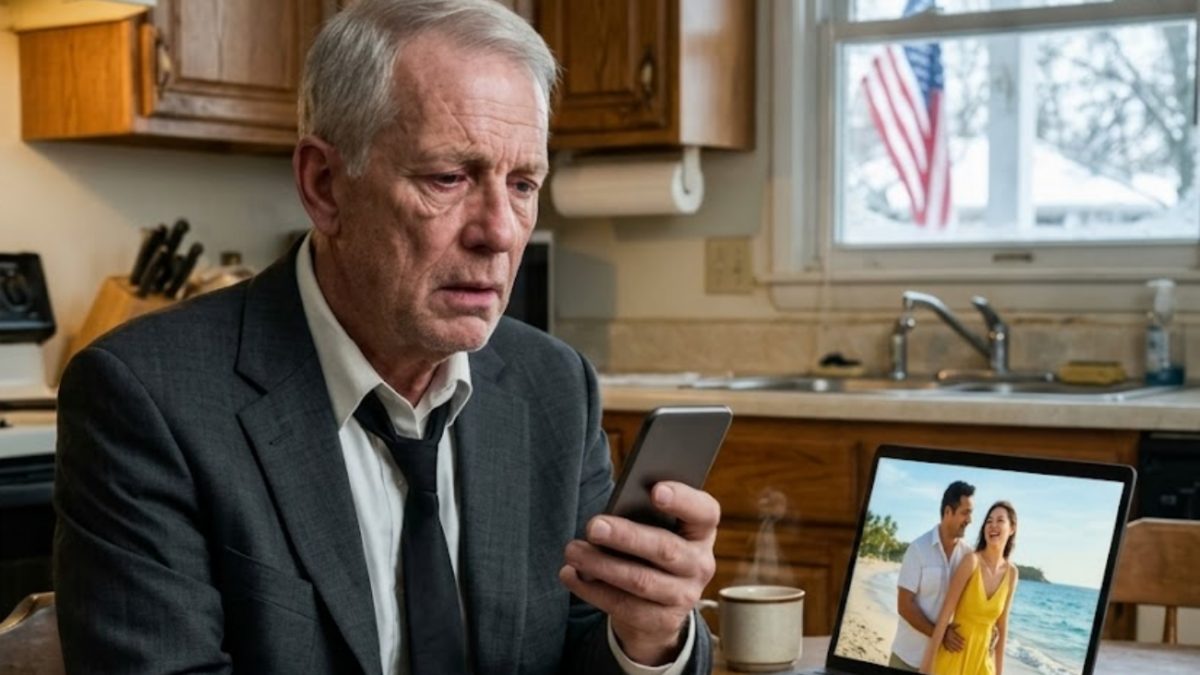
My daughter-in-law skipped my son’s funeral in Columbus. While I stood beside his casket, she posted beach photos with the man my son had hired to care for their yard, captioned “No regrets.” The next morning, still wearing my funeral suit, I received a text from my son’s number: “Pop, get in your car and come to the house. Don’t tell a soul.”
My daughter-in-law didn’t come to my son’s burial.
She didn’t send flowers. She didn’t call that morning to ask whether I needed someone to drive me.
Forty-one people stood with me in a Columbus cemetery on a cold Thursday in November. Tanya wasn’t one of them.
The next morning, her sister sent me a photograph.
Tanya was standing on a beach beside Alejandro Cruz, the landscaper Danny had hired the previous spring. He had one hand against her back. She was laughing.
Underneath, she had written: No regrets, only forward.
I was still looking at that photograph when my phone buzzed.
The message came from my son’s number.
Pop, get in your car and come to the house. Please don’t call Tanya. I need to explain something.
I called immediately.
A breath. A small, familiar clearing of the throat.
“Pop?”
I gripped the edge of my kitchen table.
“Who is this?”
“It’s me.”
I had heard that voice through forty-one years of birthdays, ball games, bad connections, and Sunday calls.
The man speaking was my son.
The day before, I had watched a casket bearing his name disappear into the ground.
My name is Walter Sutherland. I was sixty-three that November, retired from thirty-six years of maintaining heating systems in public schools.
Danny was an environmental engineer. He lived with Tanya in a Cape Cod house in Bexley, about twenty minutes from mine if traffic behaved.
They had been married nine years.
I had danced with Tanya at their wedding outside Granville. I had driven her to appointments during a medical scare and sat beside her while she twisted a tissue into a little rope.
When my wife died, Tanya brought groceries and knew which cupboard held the coffee.
Those things mattered to me afterward. Remembering them kept me from pretending I had always known what she was.
Danny’s accident happened a week before the funeral.
He and a colleague, Eric Mercer, were returning from a site visit when several vehicles collided on a wet highway south of Columbus. They were taken to different hospitals.
The call I received said my son had died.
I remember asking the woman to repeat his name.
Then I asked whether she was sure.
She told me the identification had been made.
Later, I learned how much had been concealed inside that sentence.
At the time, I heard only that Danny was gone.
Tanya was in Savannah, visiting her mother. When I called, she made a sound that caused me to pull the phone away from my ear.
She said she would come home.
By Friday afternoon, she had spoken with the funeral director and authorized me to handle the arrangements. She said she couldn’t manage the decisions.
The director explained that the injuries made a private, closed-casket service advisable. I asked to see Danny anyway.
He didn’t refuse. He spoke gently about what I might remember afterward.
Tanya called while I was sitting in the arrangement room.
“Please, Walter,” she said. “Let us remember him the way he was.”
I had already buried my wife. I knew grief could make a person need things other people didn’t understand.
I agreed.
That agreement would wake me in the night for months.
Tanya kept postponing her flight.
First her mother was unwell. Then she said she couldn’t stop shaking long enough to pack.
By Monday, I was offering to fly down and bring her home myself.
“No,” she said quickly. “You have enough to do.”
Her sister Renee called me Tuesday evening.
“Has she given you a flight number?”
“Not yet.”
“She won’t give me one either.”
We made excuses for her together.
On Wednesday, I left two messages about the service. In the second, I told her I had saved a seat beside me.
She didn’t answer.
Thursday morning, I put on the suit I had worn to my wife’s funeral. The trousers were loose at the waist. I had eaten mostly toast for a week.
At the cemetery, Pastor Coleman asked whether we should wait a few minutes.
I looked toward the entrance.
“No,” I said.
Danny had coached Little League for six seasons. Two former players came with their fathers. His neighbor brought the gloves Danny had borrowed to clear a fallen branch.
People stood close enough that our coat sleeves touched.
I counted them because numbers were easier to hold than anything else.
Forty-one.
When it was over, Renee walked me to my car.
“I’m sorry,” she said.
“You didn’t do anything.”
“I know. I’m still sorry.”
She called the following morning about the photograph.
“I didn’t want you finding it by yourself.”
She sent screenshots from Tanya’s public account. Restaurant tables. A rental balcony. Fourteen posts since the accident.
The beach photograph had gone up during the service.
I enlarged Alejandro’s face. I had met him at two cookouts. Once, Danny had sent him home with half a tray of ribs.
I set my phone down and opened the kitchen drawer where I kept spare batteries, rubber bands, and things without another place.
Then I closed it.
I couldn’t remember what I had wanted.
That was when Danny’s message arrived.
“Stay on the phone,” I told him.
“All right.”
“Say something.”
“What?”
“Anything.”
He swallowed.
“You still owe me a rematch at cribbage.”
I bent forward over the table.
At our last game, he had accused me of hiding a five. I had told him forty-one was too old to complain about losing to his father.
“Where are you?”
“Home. Aaron’s here.”
Aaron Faulk had been Danny’s college roommate. He was a physician, though he had never been Danny’s treating doctor.
“Are you hurt?”
“A little. I’m getting better.”
“Don’t hang up.”
“I won’t.”
I stayed connected while I put on my shoes and found my keys. Before I backed out of the driveway, Aaron took the phone.
“Walter, he’s here. He’s been discharged. I drove him.”
“Did you know?”
“No. He reached me this morning.”
There was enough firmness in his answer to get me onto the road.
Danny’s house looked exactly as it had when I stopped there earlier that week to bring in the mail.
A pumpkin had softened beside the front steps. Tanya’s ceramic planter stood empty near the railing.
Aaron opened the door before I reached it.
Danny was sitting at the kitchen island in gray sweatpants and an old sweatshirt. There was a healing cut near his hairline. One hand rested against his ribs.
He started to stand.
“Don’t,” Aaron said.
I crossed the kitchen and put my hands on Danny’s shoulders.
He was warm.
I could feel him breathing.
For a moment, neither of us spoke.
Then he said, “I didn’t know you thought I was dead.”
I pulled a stool out too hard. One leg scraped across the tile.
“I buried you.”
His face crumpled.
“I know. Aaron told me.”
I sat down before my knees gave way.
The explanation came in pieces.
Danny remembered rain, brake lights, and Eric reaching toward the dashboard.
After that, he remembered being frightened by a tube and someone telling him not to pull at it.
He had suffered a head injury, broken ribs, and a significant lung injury. For part of the week, he had needed a ventilator and sedation. Afterward, he had been confused and exhausted.
At the scene, the belongings and identities of the two men had been mixed up. Eric had been admitted under Danny’s name. Danny had been admitted under Eric’s.
Eric died.
Danny survived.
The records that should have exposed the mistake hadn’t been reconciled. Separate hospitals had treated the names attached to their patients as established information.
There were explanations afterward: damaged identification, hurried handoffs, assumptions copied into later records.
None of them made the mistake small.
Eric lived alone. His emergency contact information was outdated, and the hospital treating Danny had struggled to reach anyone connected with the name in his chart.
Meanwhile, I had been answering questions about my son’s middle name, birthplace, and mother.
Every accurate answer had been added to the wrong man’s paperwork.
“I kept telling them things that didn’t match,” Danny said. “But I wasn’t making much sense at first.”
He looked down at his hand.
“Sometimes I thought I was at work. Once I asked whether Mom was coming.”
I pressed my palms together under the island.
Aaron explained that Danny had become consistently clear only toward the end of the week. That Friday morning, he had insisted that the name on his paperwork was wrong.
A staff member had helped him call Aaron.
Danny remembered Aaron’s number from years before cell phones remembered everything for us.
“I got there, and they were already trying to sort it out,” Aaron said. “He gave permission for me to help. We’ve spoken with the people who need to know. The hospital. The other hospital. The coroner’s office.”
“The cemetery?”
“They’ll be contacted too.”
I looked at Danny.
“Why didn’t you call me?”
“I tried through Tanya.”
He took a slow breath.
“On Tuesday.”
A nurse had helped him make one brief call that afternoon.
Danny had asked for his wife. He remembered her number, and the nurse had dialed it.
He was weak, hoarse, and still drifting in and out of sleep.
Tanya answered.
“She kept saying my name,” he told me. “I thought she was crying because of the accident.”
He had asked about me.
“She said you were resting. She said everybody knew I was improving.”
I stared at him.
“She said that?”
He nodded.
“She told me not to worry about anything at home. Then I couldn’t stay awake.”
The call was noted in his chart. A successful conversation with the patient’s wife. Family aware of his condition.
A simple note that should have meant someone was looking after him.
“She knew Tuesday,” I said.
Danny rubbed his forehead.
“I don’t understand why she didn’t come.”
I thought of my message Wednesday evening.
I have saved you a seat beside me.
Tanya had listened to that message knowing he was alive.
“Where’s your phone?” I asked.
“Here.”
It had been at the house throughout the accident, charging beside the bed. I had seen it when I collected his suit. I had left it there because Tanya might want it.
Aaron had brought Danny home after discharge and stayed while he showered and changed. Danny had picked up his phone, seen my unanswered calls, and asked what had happened.
Aaron had already found the funeral notice.
That was when Danny sent the message.
“I didn’t want you calling her first,” Danny said. “I needed to hear what she’d told you.”
I reached across the island and covered his hand.
For several minutes, the only sound was Aaron rinsing a mug at the sink.
We called an attorney that afternoon.
Eleanor Winslow had prepared Danny and Tanya’s wills several years earlier. Because she had represented both of them in that work, she explained that she could not advise Danny against Tanya in a divorce.
She could help him identify urgent administrative problems and refer him to separate counsel.
Her first questions were practical.
Was he safe? Had the mistaken identification been reported? Had anyone started handling his estate or claiming benefits?
Danny didn’t know.
He opened the household filing drawer.
The life insurance folder was where it had always been, beneath the mortgage papers.
Eight hundred fifty thousand dollars.
Tanya was the beneficiary.
There was nothing suspicious about that by itself. They had a mortgage. They had planned a life together. Danny had wanted his wife to be secure if something happened to him.
He called the insurer using the number on the policy.
After a series of questions, he was transferred twice.
Then the representative asked whether he could remain available for verification and provide supporting records.
A claim had been opened Monday.
There had been additional contact Thursday morning.
“Before the funeral,” I said.
Danny held up one hand, listening.
When the call ended, he set the phone flat on the counter.
“She told them nothing had changed.”
He said it without raising his voice.
The company hadn’t paid the claim. It was still being processed.
Eleanor helped him send written notice and arranged for the appropriate records to follow. The insurer began its own review.
Nobody needed me to become the executor of anything. Nobody needed a judge to give a father special authority.
They needed proof that the insured man was alive.
Danny sat in his kitchen and supplied it.
That evening, I drove him to my house.
Aaron helped carry the discharge papers and a small bag of clothes. Before leaving, he went through the follow-up instructions with Danny and made certain we knew whom to call if his breathing worsened.
There was no whispered arrangement, no promise to hide him.
He needed rest, medical follow-up, and someone who would notice if he got into trouble.
I made scrambled eggs.
He ate half, then apologized.
“Don’t start apologizing for eggs.”
He tried to smile.
I put clean sheets on the spare bed. The room still contained his old high school baseball glove and a box of Christmas decorations.
At the doorway, he stopped.
“What did you say?”
“When?”
“At the funeral.”
I folded the towel I was carrying.
“I talked about you teaching those boys to lose without blaming the umpire.”
He looked at the floor.
“And your mother.”
“What about her?”
“That she would have liked the man you became.”
He sat on the bed.
I stayed beside him until he could look up again.
Tanya called Saturday morning.
I was washing the pan from breakfast. Danny was asleep down the hall.
“The insurance company left me a message,” she said. “They’re reviewing something. Did you call them?”
“Why?”
“Because they asked about information from the family.”
I dried my hands slowly.
“Where are you, Tanya?”
“With my mother.”
“I saw the photographs.”
She was quiet.
“I needed to get away.”
“You could have told me you weren’t coming.”
“I couldn’t face it.”
I looked toward the hallway.
On Thursday, I might have accepted that answer. I might have hated it and still accepted it.
“When did you last speak to Danny?” I asked.
“Walter.”
“When?”
“Before the accident.”
I closed my eyes.
She had been offered a way to tell me. A plain question. No shouting.
“Are you sure?”
“What are you trying to do?”
I opened my eyes.
“I’m trying to hear you say something true.”
She began talking faster. About grief. About how people expected women to perform it properly. About how a photograph couldn’t explain a marriage.
I let her finish.
Then I said, “He’s here.”
The line went silent.
I could hear a television somewhere behind her.
“What?”
“Danny is here. He came home yesterday.”
A chair scraped.
“Let me talk to him.”
“He’s sleeping.”
“Walter, let me explain.”
“You spoke to him Tuesday.”
She didn’t deny it.
That was worse than anything she had said.
Finally, she whispered, “I thought there was a mistake.”
“There was.”
“I didn’t know what to do.”
“You could have called me.”
“I was going to.”
I thought of the seat beside me at the cemetery.
“When?”
She hung up.
Danny listened to the conversation later. I hadn’t recorded it, so I told him exactly what I remembered and made clear where I wasn’t certain.
He asked only one question.
“Did she ask how I was?”
“No.”
He nodded, then asked me to hand him his discharge instructions.
That afternoon, he called the attorney Eleanor had recommended.
He also called Renee.
I sat in the living room while he told her. I heard her cry out, then apologize for crying, then ask whether she could come over.
She arrived with soup and stood on my porch holding the container against her coat.
When Danny came into view behind me, she covered her mouth.
“I called her every day,” she said. “Every day.”
“I know.”
“She told me you were gone.”
Danny took the soup before she dropped it.
Renee stayed for an hour. She answered his questions and showed him the messages she had received.
Before leaving, she hugged him carefully, avoiding his injured ribs.
Then she turned to me.
“I should have pushed harder.”
“You were lied to too,” I said.
I needed someone to remind me of that same thing later.
The corrections took time.
Danny’s name being spoken aloud in a hospital office did not fix his bank records, employment records, or the death certificate.
He signed releases. He gave statements. He answered the same questions for people who were understandably reluctant to accept a telephone call as proof.
Some employees were kind. Others were simply trying to follow the procedure in front of them.
Once, after spending most of a morning being transferred between departments, he set his phone down and went into my backyard.
I found him beside the bare tomato beds.
“What happened?”
“They need another certified copy of something.”
“Which thing?”
He laughed once.
“I don’t know anymore.”
I handed him the rake leaning against the shed.
“Hold this.”
“Why?”
“So you can say you helped me.”
We stood there for a while without working.
At his follow-up appointment, the doctor told him recovery would be uneven. He could have a decent morning and still be exhausted by lunch.
I started keeping a chair near the stove so he could talk to me while I cooked.
He complained that I put too much pepper in everything.
I told him he was welcome to take over.
The next night, he did.
There was another family to consider.
Eric Mercer was forty-three. He had an older brother in Michigan from whom he had been estranged.
The authorities found him during the identification review.
For days, I couldn’t stop thinking about the casket.
Eric’s brother had been given no chance to say goodbye at all.
Through the funeral home, I asked whether he would accept a letter.
I wrote it three times.
In the final version, I told him I was sorry, that his brother had been treated with care at the service, and that Danny remembered him talking about an old fishing boat he hoped to repair.
I didn’t ask for forgiveness. I didn’t know what he would be able to give.
He wrote back two weeks later.
He said he was glad his brother hadn’t been buried alone.
I read that sentence until the paper blurred.
The arrangements for correcting the burial were handled through the responsible offices and the funeral professionals. Danny and I did not turn it into a private ceremony about our good fortune.
We sent flowers when Eric’s family held their own service.
Danny chose the card.
I was with him that morning. He was trying to get us both home.
Tanya returned to Ohio with an attorney.
Danny did not meet her alone.
She asked to see him at the house. His lawyer arranged for necessary communication and the collection of personal belongings instead.
There was no dramatic scene on the front lawn.
I drove Danny there one afternoon to retrieve clothes and work materials. Tanya wasn’t present.
In the kitchen, he stopped beside the island.
A grocery list was still attached to the refrigerator.
Milk. Dishwasher tabs. Lemons.
He read it, then took down a photograph of the two of them from a small magnet shaped like Ohio.
“Do you want that packed?” I asked.
“No.”
He put the photograph facedown on the counter.
Upstairs, he found my wife’s recipe box in Tanya’s closet, underneath several handbags.
He carried it down himself.
“I forgot she had this,” he said.
I opened the lid in the car.
My wife had written Sunday pot roast on the first card in blue ink. There was a grease mark beside the cooking time.
I kept one hand on the box all the way home.
The insurance investigation continued separately from the divorce.
Danny supplied records and consented to the release of information relevant to the claim. I gave a statement about the calls, the funeral, and what Tanya had told me.
The investigators did not treat the beach photograph as proof of a crime.
Neither did Danny’s lawyer.
A person could be a terrible spouse without committing insurance fraud. Filing a claim quickly wasn’t proof either, if the person honestly believed the death was real.
The important question was what Tanya knew when she continued pursuing payment.
The Tuesday hospital call mattered.
So did the follow-up statements to the insurer.
Later, investigators obtained messages through legal process that established what she had told Alejandro after speaking to Danny.
I did not see those messages until they became part of the case.
She had recognized his voice. She knew he was alive.
She had decided to wait.
That was the phrase I could never get past.
Wait for what?
The claim to move further? Someone else to discover the mistake? A different version of the story she could live with?
No one could answer that for me.
The financial review uncovered something else.
Over the previous eighteen months, Tanya had moved approximately sixty thousand dollars from their joint savings into an account in her own name.
Danny had known about some of the transfers. She had described them as money for taxes, household expenses, or savings she managed.
Other transfers surprised him.
His divorce attorney obtained the statements through the proper process and sorted out what had been authorized, what had been spent for marital purposes, and what remained.
Those funds hadn’t come from the insurance policy.
They weren’t automatically proof that she had planned for Danny to die.
“I need you to hear that,” his lawyer told him during a meeting I attended at his request. “We’ll establish what the records support.”
Danny nodded.
It would have been easier to call all nine years a scheme.
He resisted doing that, even when I couldn’t.
“She was there when Mom was sick,” he said one evening.
“Yes.”
“She didn’t fake every good thing.”
“I know.”
He stared at the television without turning it on.
“That makes it harder.”
I understood.
Tanya’s affair had begun before the accident.
Danny had suspected it that fall. He had asked about messages and long gaps in her day. She had told him his trouble at work was making him distrustful.
He had recently left the engineering firm where he had spent most of his career.
A development assessment had led to a dispute over contamination findings. Danny refused to change conclusions he believed were supported by the testing.
He preserved the records he was entitled to keep, sought legal advice, and reported his concerns through appropriate channels.
The dispute cost him his position.
It did not give him secret protection or a new identity. It left him angry, unemployed for a time, and worried about the mortgage.
By November, he had begun contract work. Eric had been working with him on the site they visited that Thursday.
“After the accident,” Danny said, “I kept trying to make everything connect.”
He meant the job, Tanya, the crash.
“Did somebody find something?” I asked.
“No. That’s what I’m saying. Sometimes the road is wet and somebody makes a mistake.”
He rubbed the fading mark at his hairline.
“I don’t want to spend the rest of my life looking for a plan behind everything.”
I was glad he said it.
I had started doing exactly that.
By Christmas, the immediate identification questions had been settled, though smaller administrative problems continued to surface.
Danny was walking farther. He still needed breaks and follow-up care, but he could drive short distances once his doctor cleared him.
We bought a small tree.
I had stopped putting one up after my wife died. Danny found the stand in the garage and dragged it into the kitchen.
“This leaks,” I said.
“It leaked when I was twelve.”
“And you still brought it in?”
He put a folded towel underneath.
On Christmas Eve, Renee came for dinner with her husband. Aaron stopped by afterward with a pie.
Nobody toasted second chances.
We ate too much. Renee washed dishes while I dried. Danny fell asleep in the armchair during an old movie.
When Aaron left, he looked toward the living room.
“He doing all right?”
“Some days.”
“You?”
“Some days.”
He nodded.
That was enough conversation for the porch.
The criminal case moved much more slowly than my anger.
There were interviews, records to obtain, charging decisions, and postponed dates.
Tanya’s attorney disputed how clearly she understood the first hospital call. The investigators examined that question rather than accepting our interpretation.
The later evidence mattered because it removed the uncertainty.
She eventually pleaded guilty to an insurance-fraud charge arising from her continued pursuit of the claim after learning Danny was alive.
The insurer had paid nothing.
At sentencing the following year, the judge considered the amount she had tried to obtain, her conduct, her lack of a prior record, and the other information presented by both sides.
She received a prison sentence.
I won’t pretend the number of months repaired anything.
Danny sat beside me without moving while the sentence was read.
Tanya looked back once.
He did not turn away, but he did not give her the response she seemed to be searching for.
Outside, he asked whether we could stop for lunch.
“Anywhere in particular?”
“A place with ordinary chairs.”
We found a diner with scratched tables and a waitress who called both of us honey.
He ordered a turkey sandwich.
For the first time that day, his hands were steady.
The divorce had its own timetable.
The house was eventually sold. The accounts were addressed in the settlement. Danny received what the final agreements and orders provided, rather than everything his hurt might have told him he deserved.
He did not keep Tanya’s belongings.
He did not post the case documents online.
When people called looking for details, he sometimes let the phone ring.
A local reporter left three messages.
Danny deleted them.
“I’m tired of being the thing that happened,” he said.
We were on my porch. It was early spring, and the air smelled of wet soil.
“What would you rather be?”
He thought about it.
“Working.”
A few weeks later, he told me about an opening with a small environmental consulting company near Asheville.
The work involved water sampling, site assessments, and reports that needed to be accurate even when accuracy was inconvenient.
He had spoken with the owner twice.
“They know?” I asked.
“Enough.”
“About the accident?”
“Yes.”
“Everything else?”
“They know I need to move.”
He looked out at the street.
“I’d like to go somewhere I don’t have to explain why I’m buying groceries.”
He moved first.
I drove down with him, helped unpack, and stayed a week in a rental with an unreliable toaster.
Asheville had more hills than I appreciated.
Danny enjoyed pointing this out every time I stopped on a walk.
“You said you had two good knees.”
“I said two working knees. There’s a difference.”
He laughed.
I had spent the winter listening for that laugh without admitting it.
When I went home, my house seemed unusually large.
There were rooms I barely entered. The garden could be replanted by somebody else. My wife’s things were precious because they had been hers, not because they remained inside one particular set of walls.
I called Danny on Sunday.
“How’s the apartment?”
“Quiet.”
“Mine too.”
He waited.
“I’ve been looking at places near you,” I said.
“Buying?”
“Renting first.”
Another pause.
“Pop, you don’t have to move because of me.”
“I know.”
“Are you sure?”
“I’m sure I don’t want to shovel that driveway another winter.”
He let me have the excuse.
I sold my Columbus house later that spring.
Packing took longer than the sale.
I found Danny’s report cards, a broken kitchen timer, and enough extension cords to supply a hardware store.
My neighbor Glenn came over to help and left with a ladder, two snow shovels, and a promise that I would answer the phone.
The recipe box traveled in the cab of the rented truck.
Danny met me outside my new apartment with coffee and a hand truck.
He inspected the load.
“You brought the ugly bookshelf.”
“It holds books.”
“It leans.”
“So do you when you’re tired.”
We spent the afternoon arguing about where to put it.
He wanted it beside the window. I wanted it against the longer wall.
We tried both places, scratched the floor despite our precautions, and finally left it where I had suggested first.
Danny stood back.
“You’re going to mention that forever.”
“Probably.”
He picked up an empty box and carried it outside.
I heard him laughing on the stairs.
The cemetery in Columbus no longer has my son’s name over another man’s grave.
The correction mattered to Eric’s family. It mattered to us too.
There was no reason to preserve the mistake as a monument.
When I return to visit my wife, I bring flowers and a small brush to clean around the lettering on her stone.
I tell her about Danny’s work, about his terrible new habit of calling before breakfast, about the woman at my apartment building who keeps giving me tomatoes I haven’t asked for.
Sometimes I tell her about the service.
Mostly, I talk about the things she would have wanted to hear.
That he eats better now.
That he has friends.
That he still leaves his shoes where somebody can trip over them.
Last June, Danny came with me.
He crouched to straighten the flowers, then stayed there a moment with his hand resting on the stone.
I waited by the path.
On the drive south, he fell asleep in the passenger seat.
His head tipped toward the window. One hand lay open on his knee.
At a rest stop, I bought two coffees even though I knew his would be cold before he woke.
A few miles later, he stirred.
“You should’ve woken me.”
“You looked tired.”
He lifted the cup, tasted it, and made a face.
“This is awful.”
“It was awful hot too.”
He laughed and settled back.
My phone was in the console between us. His name was still at the top of my recent calls.
Then he reached over, turned down the radio, and asked whether we could stop somewhere for supper.
I told him we could.